


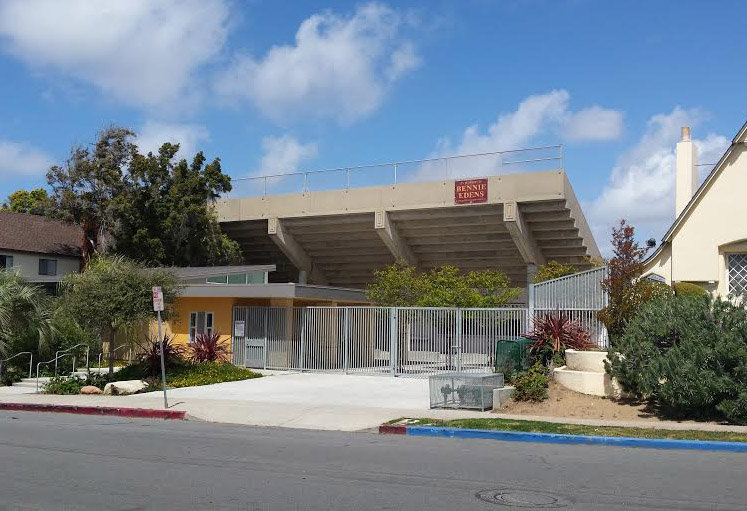
Shrugging off the implied threat of a lawsuit, San Diego Unified School District Board May 24 voted 5-0 in favor of an environmental impact report for campus and athletic facilities upgrades at Point Loma High School (PLHS), including a controversial proposal adding new stadium lights.
The school board’s vote followed nearly two hours of public testimony for and against multi-phase, master-planned modernization of PLHS campus and its athletic facilities. Founded in 1925, PLHS’ stadium was built in 1950.
A grass-roots group of neighbors surrounding the stadium have been lobbying for months against the EIR’s stadium lights component. They argue it would be a community-character buster creating more traffic, parking, noise and trash problems in an already overcrowded area.
A retired police officer cautioned that having more nighttime games might be an open invitation to gangs bringing more crime.
One stadium lights detractor argued putting them in would contribute to “creating a ghetto high school with unrestricted sports activities.”
Neighbors also expressed concern — and wanted assurances — that PLHS’ field use policy would not be “commercialized.” They fear the school’s proposal to restrict the number of nighttime events held annually could be changed. PLHS’ open-field policy limits nighttime events to 18, not including playoff games, or the use of the lights to allow completion of games and practices that carry over into darkness.
Opponents also argued that renting the stadium facility to outside interests would financially benefit SDUSD, but not PLHS students, for whom modernization is intended.
“The real focus ought to be on education at PLHS, not on athletics,” argued one neighbor opposed to the EIR’s approval, who noted students’ tenure there is “very short lived,” while neighbors “are around for lifetimes — generations.”
That remark invited a counter-response from PLHS head football coach Mike Hastings.
“That football field is my classroom and it teaches life values and skills, not only to athletes, but to every kid who’s ever been taught phys ed there,” Hastings said. “We do need these lights. Our school is only 90 years old, and will be around longer than we are, and will benefit our community for generations to come.”
Noting any proposed change in the existing PLHS open-field policy would have to come back to the SDUSD board for approval, board vice president Richard Barrera made a successful motion requiring that PLHS neighbors be given ample notice in the future should there ever be any proposed changes to the open-field policy.
“This is going to impact the quality of life of this neighborhood, creating more noise and traffic and significant, unavoidable impacts,” argued another EIR opponent.
Several students claimed new stadium lighting is absolutely essential. One band member said lighting is so poor currently that parents at their practices had to shine their car lights onto the field in order for the band to finish after-school practice.
The PLHS Whole-Site Modernization and Athletic Facilities Upgrade Project, of which proposed stadium lights is a part, is the first phase of planned long-range improvements at the school that also include demolition of the existing media center/classroom building; construction of a new three-story building, containing a new media center and 20 new classrooms; renovation of the current 200 and 300 buildings; construction of new security features allowing a single path of access to the campus during school hours; a new arched façade along Chatsworth Boulevard that will provide some connection to the school’s beloved original Spanish design; construction of turnouts for school buses to leave more space for vehicles passing in front of the campus; construction of a 150-square-foot main distribution building for better distribution of technology; and installation of overall security improvements.
Attorney Bob Ottilie, representing stadium lights opponents, said “My clients reject this proposal, which is unlawful because it violates San Diego zoning and land-use laws. The eir identifies extensive non-academic commercial uses of the athletic field.”
Warning similar school projects statewide have been rejected in court, Ottilie added, “We hope to resolve this in mediation, not litigation.” “The guiding principle for me is, is this best for the students?” asked board member Sharon Whitehurst-Payne, noting she found student discussion of the safety risk from poor lighting to be “disturbing.”
Board member John Lee Evans noted the EIR for the modernization has been a “very thorough process.”
“This is a good compromise,” said board member Kevin Beiser.
“We want to have quality schools in every neighborhood, and quality neighborhoods around every school,” concluded board president Michael McQuary. “We want to put the students and education first, as well as incorporating the needs of our community and our neighbors.”


