


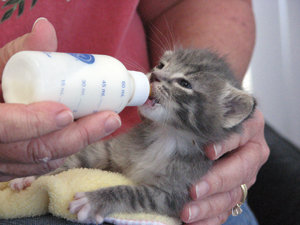
With kitten season now in full swing, San Diego County’s rescue organizations and animal shelters are experiencing their annual flood of kittens. Many are actively recruiting additional foster parents to help care for fragile newborns. Perhaps as a result of shorter winters and warmer temperatures, kitten season currently begins around March and runs through October, fully three months longer than earlier years. The results include growing bumper crops of kittens born to unspayed females, said Dawn Danielson, director of the County of San Diego’s Department of Animal Services (DAS). Many kittens arriving in shelters are newborns or “neonates” separated from their mothers and only a few hours or days old, too young to survive on their own. These must be bottle-fed every two hours to survive, as well as kept warm and manually stimulated to eliminate, just as their mothers would do for their kittens. Neonates are transferred to rescue organizations’ volunteer foster parents, if available, for round-the-clock care and feeding. No shelter or rescue has the staff or resources to care for the thousands of kittens dropped off each year. Danielson estimated that at the height of the season, DAS’ three shelters daily receive about 13 to 15 neonates in need of bottle-feeding. If foster parents are not available or the kittens are too frail or ill to survive, they are euthanized, Danielson said. “We are not going to let them go hungry or suffer. There’s no other choice,” she said. To feed and care for the kittens, rescues rely on trained kitten foster parents such as Lakeside resident Karen Williams, who has fostered kittens for about eight years through several rescue organizations, currently through San Diego Humane Society. Many animal rescue foster programs provide all or most supplies needed to care for newborns. Williams, office manager for Dona Jenkins Maritime Document Service in Point Loma, brings the kittens to work with her daily to bottle-feed them and “help them potty” every two to four hours until they’re about two weeks old, when their feeding schedule stretches to four to six hours. When the kittens (cont’d on page 7) (cont’d from page 6)reach six weeks and can eat on their own, Williams leaves them home, where her husband, Steve, a retired San Diego State University police captain, gives them lunch. “Everyone in the office helps feed and potty them,” Williams said, including Dona Jenkins’ owner Bernadine Trusso. The office kittens, who usually arrive in individual litters or groups of five or six at one to three days old, are such an institution in the tight-knit boating community around Shelter Island that many locals come to visit, play with and socialize the kittens, leading to many adoptions. Williams and Trusso laugh that everyone who works there has to like cats and can’t be allergic to them. Neonate kittens are extremely fragile and vulnerable to infection and must initially be isolated from other pets to avoid spreading any disease, Williams said. As the kittens mature, her eight adult cats, including three disabled former fosters and two dogs, help bathe, clean, cuddle and socialize the kittens. “The first kittens of the season tend to be healthier because their mothers are stronger,” and not worn out from multiple pregnancies, she said. Unspayed cats can have four litters of kittens a year, resulting in one unaltered pair of cats producing potential offspring of 420,000 kittens over a seven-year period. Having cared for so many unintended and unwanted kitten litters, Williams urges people to have their own cats spayed and neutered and not contribute to pet overpopulation. “People need to be aware (of the consequences). Whether your cats are boys or girls, just fix them. Be kind,” she said. Christine Manahan, founder of the Rosebud Society, a La Jolla-based cat and kitten rescue organization, explained that kittens do not thrive caged in shelters but fare better in a home environment where they receive individualized attention and adjust to normal family conditions and the likely presence of other pets in their future homes. Like other rescues, the Rosebud Society always needs additional cat and kitten foster parents. Manahan, who carried kittens to work in a file box as an office manager for a downtown law firm, stresses the commitment involved in fostering kittens. “(Foster parents) need to be mature, willing to commit the amount of time on a daily basis for the kittens to be old enough to be fixed and robust. People need to be patient and see it through to the end,” she said, while also stressing how much fun it is to raise a litter of playful kittens. Kittens generally stay with foster parents until they are eight weeks and weigh two pounds, when they can be altered before adoption. Some rescue organizations ask foster parents to screen potential adopters and arrange adoptions, whereas others transfer kittens to adoption centers. For Williams, parting with her “graduates” is always emotional. “When I hand them off, I bawl my eyes out,” she said. Yet she parts from them knowing she’s made a real difference by providing the kittens a healthy, happy start to their lives. How you can help Several rescue organizations specialize in fostering cats and kittens and urgently need kitten foster parents who are willing to complete training classes and commit to caring for newborn kittens until they are old enough to be “fixed” and offered for adoption. The Department of Animal Services needs “Tweenie Fosters” to care for four- to eight-week-old kittens, with all supplies provided and adoptions arranged. The following organizations actively seek dependable kitten foster parents and provide volunteer and foster information on their websites. Rosebud Society: www.therosebudsociety.com, e-mail [email protected]; (858) 459-8357 Cat Adoption Service: www.catadoptionservice.org, e-mail [email protected]; (760) 550-CATS Spay and Neuter Action Project (SNAP): www.snap-sandiego.org, e-mail [email protected]; (858) 456-0452 Rescue House: www.rescuehouse.org, e-mail [email protected]; phone (760) 591-1211 San Diego Humane Society & SPCA: www.sdhumane.org, e-mail [email protected]; (619) 243-3454 County of San Diego Department of Animal Services: www.sddac.com, Terri Green at (619) 767-2634 for “Tweenies Fosters” program.


