


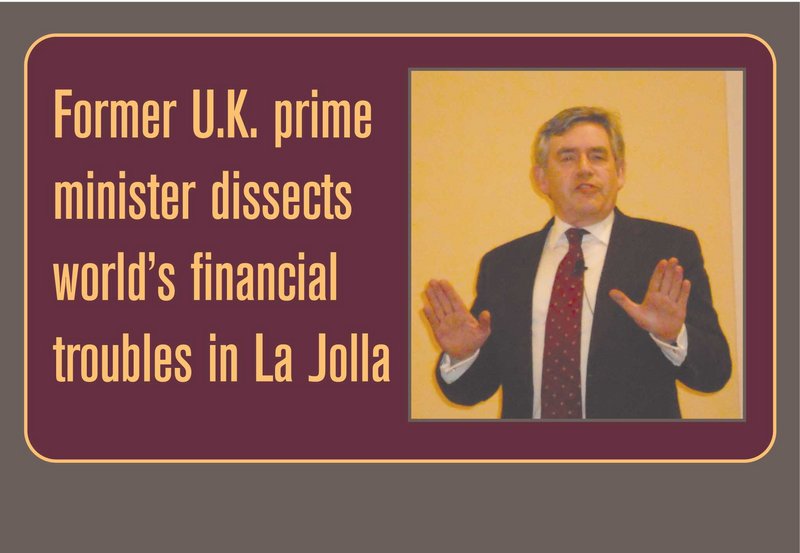
The world may be suffering from war, strife and economic collapse, but an audience in La Jolla recently had the honor of hearing from a top political mind that there is indeed hope for the future. Gordon Brown, former prime minister of the United Kingdom, spoke at the Estancia Hotel on April 3, addressing the challenges facing the globe as it ascends from 2008’s financial recession. Brown, who served as prime minister from 2007-10 and as the leader of the U.K.’s Labour Party, spoke specifically about the U.N.’s Millennium Development Goals to a packed audience at the hotel. In 2000, the United Nations created the U.N. Millennium Development Goals, laying out goals for each nation to work toward, including the development of universal primary education, the eradication of extreme poverty and hunger, and the reduction of maternal mortality by three quarters by 2015. “The changes that will occur in our lifetime will be bigger than the Industrial Revolution,” Brown said to the audience at the Estancia, pointing out that the world will soon be dealing with fundamental changes in the economy and increased globalization. Emphasizing this connectivity, he discussed the spread of the global financial crisis. “We are increasingly finding national problems to really be global problems,” he said. “And these problems can’t be solved unless we work together.” And then, to demonstrate the potential for this struggle in the future, he pointed to the difficulties in accomplishing anything on a global level regarding climate change. His presentation, however, didn’t tend only to the dark and depressing; sprinkled throughout his speech were many humorous anecdotes from his time as prime minister, especially when dealing with other prominent public figures. He then focused on the U.N. Millennium Development Goals, primarily on the goal of universal education. Although we will fail to meet most of the development goals by 2015, he said, a focus on primary education will allow many of the other goals to fall in place. “Education is the key to breaking the cycle [of poverty, hunger, etc],” he said. Brown had three solutions to ensure that all children of the world receive primary education. “One, deal with the exploitation of children and abolish child labor. Two, hold governments accountable for children not going [to school]. Three, work with non-governmental organizations working to deliver education.” One such group he mentioned was Teachers Without Borders. Audience members seemed to appreciate Brown’s approach to fixing the world’s ailments. “I was impressed with his genuine obligation to fix the global issues we are facing,” said audience member Brandon Delavar, “especially in the proper treatment and education of men and women of the future, equally.”


