


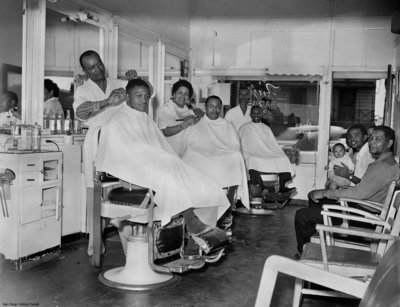
In 1991, a man named Arnold Baynard dropped off several boxes at the San Diego History Center. The boxes contained over 40 years’ worth of negatives taken by his father, Norman Baynard, who had operated a commercial photo studio in Logan Heights. Included in the box were index cards with limited information about some of the photographer’s clients — the ones who had paid for the photos, not necessarily the subjects of them. Impressed by such a vast documentation of history, but having no way to find thousands of missing names and connect them to the faces in the photographs, the history center’s staff enlisted the help of the public. By putting out a call asking the general public to help identify the subjects, the Center has started to give shape to the photographer’s account of life in Logan Heights during the 20th century. “We’ve really had a good response so far,” said Chris Travers, director of the photograph collection at the center. “We’re adding that information to our catalogue records right now. We’ve learned so many interesting stories.” So many have answered the call to unravel a little of the neighborhood’s forgotten past that the center may have enough information to display soon. Travers said an exhibition of a selection of the newly identified images will be placed on display in late-May or June. Communications associate Matthew Schiff explained the slow process of finding and documenting the information to go along with the collection. Five hundred images were selected from more than 29,000 negatives before being numbered, re-housed and catalogued. “These things take time,” he said. “They must be categorized and filed. Grants must be secured. When [Arnold Baynard] dropped off those boxes filled with stuff, that was the very beginning of a very long process that’s finally beginning to take shape as a community-driven exhibition that’ll be showcased.” The National Endowment for the Arts (NEA) provided the original funding for the project. Additional grants were provided by the James Irvine Foundation, the Charles and Ruth Billingsley Foundation, the Heller Foundation and Union Bank. Though cataloguing the images ends in May, the center will welcome information beyond this period. Baynard, a resident of Logan Heights since the 1930s, documented San Diego’s African-American community and its activities through the work he did photographing individuals and groups at various events and social gatherings, up until his death in 1986. His photographs chronicle everything from baptisms to birthday parties, from barbershop gatherings to political rallies. Identifying the people and events captured in Baynard’s photographs must be done sooner rather than later, Travers said. The more time that passes, the less likely it will be that historians will find people that have information about the eras recorded in the photos. “We are so grateful to the Baynard family for bringing this amazing collection to the History Center and feel fortunate that the funding was at last secured to make it public,” Travers said. “It’s been a very rewarding experience. If you have information about the people or events in Baynard’s photographs, contact Travers at [email protected].


