


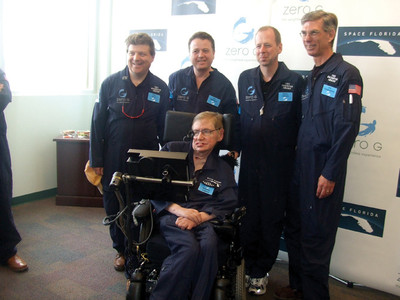
A University of California, San Diego adjunct associate professor of surgery/otolaryngology and cognitive science recently was asked to assist Professor Stephen Hawking.
Hawking is a world-renowned astrophysicist, physicist and cosmologist. Recently he had a hankering to fly in zero gravity.
The UCSD professor lucky enough to go along was Erik Viirre, M.D., Ph.D., from UC San Diego Medical Center.
“It was a thrilling trip,” Viirre said. “While every moment felt spontaneous, the medical care was planned down to every detail. Every breath and every heartbeat was monitored.”
Hawking’s recent flight onboard a Zero Gravity Corporation airplane was widely publicized and covered by the media.
Hawking is confined to a wheelchair with amyotrophic lateral sclerosis (ALS), or Lou Gehrig’s disease. The disease is a progressive neurodegenerative disorder that affects nerve cells in the brain and the spinal cord, often causing paralysis throughout the body.
He was able to float free in a zero-gravity environment.
Viirre and his team developed a health profile and motion sickness program for Zero Gravity Corporation. Viirre was also asked to provide medical oversight on the trip.
“Once we were doing weightlessness successfully with Professor Hawking, we had fun,” Viirre said. “Prior to that we were working on our safety procedures and didn’t have much time for taking advantage of weightlessness. It is a great deal of fun, where you can just float in the air or walk like an astronaut and do flips and turns.”
Zero Gravity Corporation is a U.S. company that offers FAA-approved weightless flights for the general public. Viirre serves as the company’s volunteer chief medical officer.
By controlling what is eaten before a flight, maintaining a cool, ventilated cabin, prescribing oral medication and timing the orientation of the body throughout the flight, 98 percent of passengers on zero-gravity flights experience no nausea.
“During the flight I was collaborating with the medical team to ensure Professor Hawking’s safety,” Viirre said. “My particular responsibility was to oversee that Professor Hawking’s limbs didn’t get injured.”
Because Hawking has been in a wheelchair for 40 years, his bones are thin and brittle.
“During weightlessness, we lifted him up in the air, and once the period of weightlessness is over, and the high gravity part of the parabola occurs, we had to get him securely on the floor,” Viirre said. “I had to be able to see him and make sure his arms and legs didn’t get caught underneath him.”
In addition to the private enterprise-based Zero Gravity Corporation, NASA’s (National Aeronautical Space Administration) zero gravity plane has a reputation as the “vomit comet.”
“But truth is, most zero-gravity passengers experience little motion sickness whatsoever,” Viirre said. “Weightlessness occurs when the plane enters 25-second plunges, called parabolas. Every step is taken for passengers to experience an enjoyable flight."
Exciting and exhilarating as it was, Viirre and his team practiced cardiac life support drills while dropping 2 miles per minute.
To prepare for the flight event, Viirre trained for several months.
“I coordinated the team of physicians doing the preparations, including developing the procedures for the flights and coordinating equipment,” he said. “On April 25, we had a practice flight where we had a high-school student who was about the same size and weight as Dr. Hawking.
“He was a stand-in, or float-in, if you will, for Professor Hawking.”
The team practiced weightless procedures and emergency medical responses ahead of time.
“We met with the NASA emergency medical team at the Kennedy Space Center, where the flight took place, and we checked on equipment and response plans,” Viirre added.
Using a stand-in patient, the team monitored the person’s vital signs and performed chest compressions to simulate an emergency situation.
When flight day finally arrived on April 26, Viirre and 30 passengers enjoyed several periods of weightlessness during the two-hour flight over the Atlantic Ocean.
“Hawking was managing the flight,” Viirre said. “He was smiling and smiling. Instead of stopping at the one planned parabola, we did eight.”
Viirre also serves on the board of the San Diego Air and Space Museum.
He believes that the experience of weightlessness should be available to science teachers, and is currently involved in an initiative to help hundreds of schoolteachers access zero-gravity flights at no cost.
The Air and Space Museum is working with Zero Gravity Corporation to present a teacher development program to San Diego educators. It is scheduled to take off later this year. Teachers who have the chance to participate in the “Zero G” teacher program will have a variety of benefits.
“Teachers will get the training that all passengers for Zero G get, including meeting an astronaut, understanding how we create weightlessness and coming up with a plan on what to do in the flight,” Viirre said. “They will have the opportunity to plan experiments, such as floating liquids in weightlessness and making gravity-measuring instruments.”
After the flight, teachers will be able to contemplate their experiences, review the physics of gravity and relativity and share that information and insight with students.
“Most importantly, as Professor Hawking wanted, they’ll be able to bring the experience of space flight and its importance tangibly closer to the classroom,” Viirre said.
The most important part of the experience is that it is available for all kinds of people, not just astronauts, Viirre said.
“We showed that with Professor Hawking, even a person who has been in a wheelchair for 40 years can go,” he said. “It is not for everybody, so if you have had a recent injury, have a heart problem or are pregnant, you might not be able to go right away. We try to work with people’s doctors to make sure that people can safely go.”
Zero Gravity Corporation has operations based out of the Kennedy Space Center in Florida and McCarran Airport in Las Vegas.
For more information, visit www.gozerog.com.


