


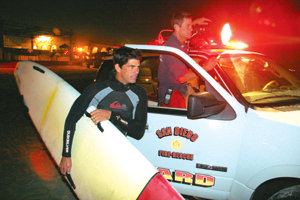
As nighttime falls, businesses close up shop and residents prepare for bed. At the same time, San Diego Fire-Rescue Department lifeguards prepare for a night of duty that could pull them to any location from three miles off the coast to Sunset Cliffs to Windansea. A team of five lifeguards monitors San Diego beaches and shorelines between La Jolla and the tip of Point Loma and three miles out to sea during the nighttime hours, every night of the year. One serves as the dispatcher, receiving 911 calls and monitoring radio frequencies, while the other four are sent out on calls — or catch some sleep, prepared to be called to duty at a moment’s notice. Two are positioned in La Jolla and two are positioned with the dispatcher at headquarters on the south side of Mission Bay. “If there’s an area farther than that, we have to get approval, but we will still go,” said Sgt. Bill Bender, a night crew lifeguard who has been with the service since 1981. “The San Diego Lifeguard Services is viewed as one of the most professional lifeguard agencies in the U.S. due to the breadth of responsibilities they perform and the quality of their work,” said Chris Brewster, president of the United States Lifesaving Association and former San Diego lifeguard chief. San Diego lifeguards are part of the San Diego Fire-Rescue Department’s Lifeguard Services. They are trained firefighters and sworn peace officers, able to make arrests and write citations, in addition to their lifeguarding responsibilities. Those responsibilities encompass swift river rescues, offshore search and rescue work requiring scuba certification, cliff rescues and the more commonly-seen ocean rescues and medical aids. Calls can come at any hour and require quick responses using various skill sets. In the summer of 1983, two lifeguards were kept on duty overnight to respond to increasing emergency calls. The program, proving valuable, became implemented 365 days per year in 1984. “We are the initial responders,” Bender said. The lifeguards on duty on a recent night at the Mission Bay location were Bender; Marc Brown, Lifeguard II; and Daryl McDonald, Lifeguard III; with a combined total of more than 65 years of lifeguarding experience between them. Boating emergencies are a majority of the calls that can come in on any given night. Emergency calls for boats that are sinking, disabled, on fire — or boaters calling for medical aid for those aboard — are all sent to the dispatch lifeguard. “Mission Bay is one of the major outlets as far as smuggling is concerned because San Diego Bay is so inundated with Homeland Security and San Diego Harbor Police, so now they [smugglers] are starting to work their way up,” Brown said. “Mission Bay, Ocean Beach and all of Torrey Pines has been recently an avenue as far as dumping off illegals or running boats with drugs in them, so we will get calls to that.” When they are notified about suspicious boats, the number one priority remains safety when responding. Their reaction echoes that priority, announcing, “We are here to rescue you,” they said. Once they take the suspicious boat or boaters to safety, lifeguards alert the necessary authorities to investigate further. “We are in direct contact with other state agencies,” McDonald said. The lifeguards work with the San Diego Police Department, state Fish and Game Department, U.S. Border Patrol and Coast Guard on any given night. Firefighting boats, patrol boats, buoys with attached lights, fire hoses, handcuffs, first aid supplies are all available for the lifeguards on their way to a call. “Variety is the best part of the job,” Bender said. He can go from responding to a beach rescue involving jumping off the Ocean Beach Pier at 2 a.m. into 56-degree water in the middle of winter to going out on a scuba dive rescue in a matter of minutes. “What you get is what you get, and it’s not what you expect,” Brown said. Lobster season begins Saturday, Oct. 2, and the guards anticipate a higher incidence of calls from kayakers and boaters who will be in the water along the coast at all hours of the evening and early mornings. Other conditions that may lead to a higher call volume are winter storms, high surf and heavy fog. Those who use the beaches and ocean waters around San Diego during off-peak hours include surfers, kayakers and fishermen, to name a few — and the night crew is ready and able to respond to any of them should they need help.


