


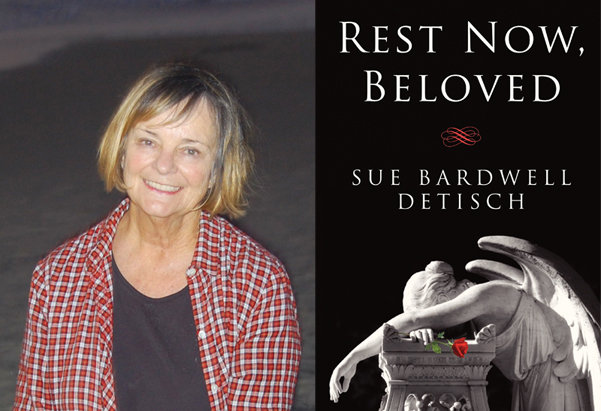
Sue Detisch had just returned from Glen Abbey Memorial Park in Bonita, where she had placed a red rose on the grave of a 7-year-old boy she never met. She grieved his 1933 death as if he were her own. In a way, he is her own. Detisch, a University City resident and a former La Jolla High School English teacher, recently wrote and published a book based on the unsolved murder of young Christopher Abkhazian. “Rest Now, Beloved” bears her pseudonym, Blake S. Lee, as the author. Based on a true cold case in San Diego, this mismanaged murder case carried no closure for this child. “Every child who is victimized has to have his voice expressed,” Detisch said. “I had to be the voice to give this child closure, if not justice.” Christopher’s death took place during the latter days of Prohibition in San Diego. Some said it was accidental; pathologists disagreed. The case gathered dust for over 60 years – and when forensic detectives reopened the investigation in 1990, they expect to put the case to rest – but this victim demands justice, not obscurity. Ex-policeman Pete McGraw, a chief detective in 1933, believes this investigation has been purposely mishandled and that there is a cover-up. From there, a reporter begins delving. As the truth unfolds, she steps on a land mine when she uncovers a dark and deadly family secret – a secret they would kill to keep buried. Detisch took a research history class at USD in 1990 and learned how to navigate archives and public domain. The instructor gave each grad student the name of a victim of a heinous local crime and had the student research places like newspapers, property zoning and birth records, the paper trail common to research before computer technology exploded. “Fifteen years went by,” she said – “and in 2005, I picked up the unfinished manuscript and dusted it off. It was 72 years after the unsolved murder when the sheriffs brought it out in 2005.” She smiled thoughtfully and whispered, “I always wanted to be a writer.” 1930s San Diego was an open city, where kids rode streetcars by themselves, went to the waterfront, the zoo, the airport. It was a city at a political crossroads. Some locals wanted it to stay a small town with family values. Others preferred it to become like Vegas, to pull in the money tourists were spending in Tijuana. There was also a revolving door for police chiefs. “I even visit with relatives of some charaxters who lived at the time,” Detisch said. “Some of the characters are a composite of many people who worked the case. I talked to the brother of a suspect and the sheriffs who had been around. You blur the lines between fiction and reality, sensitive to who lived then, distancing between real names.” At the Scripps Institute of Oceanography library, Detisch compared witness statements of 1933 with tidal records and weather reports. One suspect was broken and blind at the end of his life, but his memory and sensitivities were as fresh as if no time had passed. She also met witnesses who knew the victim and the suspects. The process of writing wasn’t new to Detisch. “I had written three novels of various subjects and eventually put them into the closet,” she said. “My husband pushed me to publish this book.” After all, she had written each sentence 40 times. “You want to find the perfect word,” she smiled. “Rest Now, Beloved,” published last September by Createspace Independent Publishing Platform, had a first edition of 800 pages; the colloquialisms of the ’30s had her turning to slang dictionaries. Detisch credits Lisa Wolff, her editor, with helping pare it to 400 pages; and finally, the published story is a readable 330 pages. “This book,” Detisch said, “is my child.” Meanwhile, she admits you need a muse to keep yourself motivated when you’re on empty; “Other days, you can’t write enough.” Trying to keep the voice in each of the characters was a challenge, editing over and over again. “I speak to a lot of book clubs,” Detisch continued. “One person asked me if I were the female protagonist, a U/T journalist in 1990 who dug into the case. No, I wasn’t. You don’t know where research is going to take you, just as you don’t know where the writing will take you.” As someone said, “Writing is rewriting.” “Writing is a lonely occupation, too,” Detisch said. “When you are older, life gets in the way of writing; kids, husband, grandkids need your attention and time. You have to see the business side of it also. Getting a book published can be expensive.” “I did feel a catharsis once the book was finished, especially looking at the cover… a sense of pride. I had in mind a final cover with his resting place in black and white and a bright red rose. A sense of sadness washed over me, too. I felt impassioned by each of the characters. In hindsight, you look at their whole lives, and many died as tragically as they lived.” “Rest Now, Beloved” can be purchased at barnesandnoble.com and amazon.com in Kindle or paperback. Please check Detisch’s Facebook page: “Rest Now Beloved.” Detisch will be speaking at University Community Library, 4155 Governor Drive, on Wednesday, June 8 at 2 p.m. She would be happy to speak to other book clubs about her book. Kirkus Reviews describes her writing as “engrossing prose rooted in specific detail that wonderfully evokes the setting of San Diego, both contemporary and historical.”


