


Reawakening the pros and cons of the Plaza de Panama project
Por Dave Schwab
While the recent resurrection of the Balboa Park Plaza de Panama project has revived hopes of creating a more pedestrian-friendly public park space, it has also reawakening much of the same opposition that derailed the proposal initially.
On Nov. 14, the City Council approved the $79 million, long-stalled Balboa Park Plaza de Panama project, which would remove traffic from the historic heart of Balboa Park, while creating 6.3 acres of parkland, gardens and pedestrian-friendly plazas.
Proponents hope Plaza de Panama construction can begin next spring and be done in time to celebrate Balboa Park’s 150th anniversary in 2018. The original goal had been to complete it by 2015, the 100th anniversary of the Panama-California Exposition.
“In terms of project scope, it has not changed,” said Katherine Johnston, the city’s director of infrastructure and budget policy. “The design is almost the same, with some minor updates to ensure compliance with all existing regulations.”

Bruce Coons, head of the preservationist organization, Save Our Heritage Organisation (SOHO), which sued to block the project back in 2012, agreed the project hasn’t changed much, despite the increase in costs.
“It is the same as the previous project except for some storm water controls,” Coons said. “I also think they added mechanical ventilation to the garage.”
Originally championed by a committee led by Qualcomm founder and philanthropist Irwin Jacobs, the Plaza de Panama project was proposed to solve Balboa Park’s chronic traffic and parking woes.
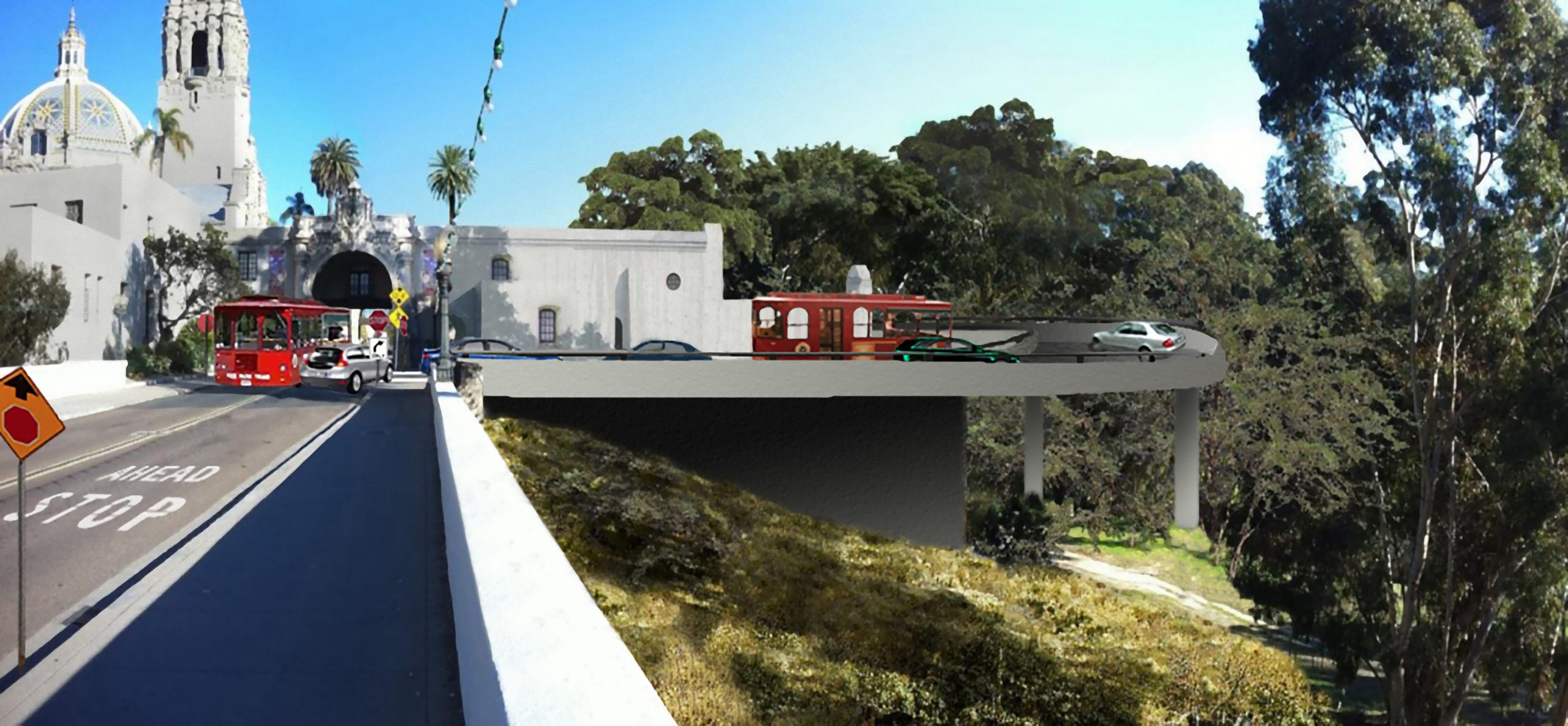
The project’s centerpiece was a bypass off the Cabrillo Bridge with motorists turning right onto the Centennial Bridge leading to a road through the Alcazar Garden parking lot culminating below new walkways to an 800-space, paid-parking, park-topped garage south of the Spreckels Organ Pavilion.
 Those changes would make it possible to end traffic and parking in the Plaza de Panama in front of the San Diego Museum of Art, the Plaza de California in front of the San Diego Museum of Man, the west Prado, and the Esplanade that leads to the Spreckels Organ Pavilion.
“We successfully fought and won [against the development] in 2013 and then the Plaza de Panama Committee — not the city — filed an appeal,” said Alana Coons, also of SOHO. “SOHO cross-appealed, but sadly, [the committee] prevailed in appeals court. Then in Jan. 8, 2016, Superior Court Judge Timothy Taylor decided against awarding $96,000 in legal fees to the Plaza de Panama Committee.”
She said that Dr. Jacobs is currently appealing that ruling.
San Diego Mayor Kevin Faulconer hailed the renewed Plaza de Panama project as “a once-in-a-lifetime opportunity to transform San Diego’s crown jewel for the next century.”
“This public-private partnership will reclaim the heart of Balboa Park for pedestrians and return the Plaza de Panama to its original grandeur,” Faulconer said. “With the support from the City Council and great civic leaders like Dr. Irwin Jacobs, the grand restoration of Balboa Park can finally begin.”
But not everyone, including SOHO, are happy that the Plaza de Panama project is back.
“If ever the commercial development of the park goes forward complete with freeway off-ramp; a giant ditch with 42-inch-tall safety railings and massive, concrete retaining walls; dangerously narrow, sunken S-curve roadway; and paid-parking structure — the cherished entry [across the Cabrillo Bridge] will not only be forever lost, it will become a garish, concrete-and-asphalt nightmare that permanently scars Alcazar Garden, Palm Canyon, Spreckels Organ Pavilion, and the historic core,” Bruce Coons said.
Coons estimated more than $300 million is needed just for crucial park repairs.
“Yet, instead of addressing the park’s urgent needs, a plan to spend more on building unnecessary and destructive new roads and buildings that require additional maintenance and expense is the city’s focus,” he said. “This is irresponsible fiscal policy and does not make any sense.”
Plaza de Panama Project plans also include:
- A completely car-free Plaza de Panama with major aesthetic improvements, including reflecting pools and more pedestrian amenities.
- A three-level underground parking garage behind the Speckels Organ Pavilion with a 2.2-acre rooftop park and 797 paid-parking spaces. Thousands of parking spaces in the park — the vast majority — will remain free.
- Improved parking with an increase of more than 30 percent in the number of parking spaces of accessible parking spaces in the core of the park, including in the parking structure and a reconfigured Alcazar parking lot.
“This is a major park renovation that will permanently create 6 acres of parkland,” Johnston said. “It’s really a grand restoration of the park.”
Bruce Coons challenged the city’s projections for what Plaza de Panama’s redo will accomplish.
“When they brag the project brings 6.2 acres of new parkland, they conveniently forget to deduct for their roadways and the huge Plaza de Panama, which was already returned to pedestrian use two years ago,” he said. “Or recognize the zoo’s new parking facility reduces the need for new parking structures, or that ADA access will be severely impacted. Nor is the new lawn they depict above their partially subterranean garage truly two new acres of parkland, as it will be significantly reduced with four new buildings and service shafts.
“Unquestionably, this ill-conceived paving and paid-parking project will destroy the historic character, scale, and natural landscapes of one of the most majestic urban parks in America,” Coons concluded. “Thirty other environmental community groups and organizations including six neighborhood planning groups also have opposed this boondoggle.”
Johnston said the redevelopment project’s estimated total cost is now $79 million, revised upward from the 2012 cost estimate of $45 million, reflecting updated state development regulations, the applicability of prevailing wage and a less-competitive bidding market.
“The city’s portion of the project will be capped at $45 million,” Johnston said, adding the remainder will be paid from “lease revenues through parking revenue in Balboa” and other monies, including private donations.
SOHO has drafted a legal response to the city regarding Plaza de Panama and recently launched a legal defense fund campaign to fight the revived project. To read their legal response, visit tinyurl.com/gt6pnzz. To review SOHO’s legal campaign funding page, visit tinyurl.com/hgz37wa.
For more information about how Balboa Park currently looks and how this project hopes to change it, visit tinyurl.com/h9b3l46.
— Dave Schwab puede ser contactado en [email protected].


