


After six years of writing Tide Lines, my monthly column in the La Jolla Village News, I took a break to complete my graduate degree. Now I’m diving back into newspaper writing but with a twice-monthly column ” the first and second Thursdays ” to bring you more tales about our local ocean realm.
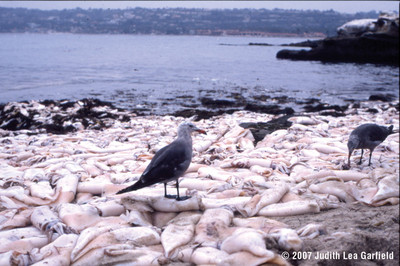
Early one overcast morning, July 27, 2002, my swim buddy, Sydney “the Golden Seal” retriever””husky, and I entered the water off the Marine Room for our daily swim to La Jolla Cove and back. We swam on until we butted tentacles with thousands of densely packed dead, floating squid that filled the Cove’s waters all the way to the high tide line. Back at the Marine Room, Syd and I revisited the Cove, this time for a landlubber’s view of the squid panorama. While the humans gawked, the birds breakfasted on squid heads, giving new meaning to seafood as brain food.
Was this invasion a freak event or a harbinger of things to come? Dr. Eric Hochberg, curator of Invertebrate Zoology at the Santa Barbara Museum of Natural History, described the 2002 invasion of the juvenile squid as one of about a half-dozen other Humboldt squid (Dosidicus gigas) strandings that have been recorded along the California coast over the past century.
However, this invasion was different in that it marked potentially permanent changes to our local ecosystem. Instead of an invasion, it appears to be a migration. Beginning this century, this squid species has increased its home range, which has resulted in secure stable, local populations along the Eastern Pacific (San Diego to the Gulf of Alaska).
Historically, Humboldt squid have not been part of our permanent marine ecosystem. Born in the warmer waters off Mexico and Central America, they are supposed to migrate south to reside as adults in the cold-water Humboldt current that cycles off South America.
This past week, scientists gathered for the annual CalCOFI (California Cooperative Oceanic Fisheries Investigations) conference at Hubbs-SeaWorld Research Institute, where Dosidicus gigas was on the menu, and research results were served up throughout the day. What environmental changes may have allowed them to expand? How will these new squid populations impact the present ecosystem? Humboldt squid live only one year but grow to 4 feet long. To meet their voracious energy demands, they must eat up to 10 percent of their body weight per day. Stanford University marine biologist William Gilly put it into perspective: “Their growth spurt may be equivalent to a human baby growing to the size of four blue whales in a year.”
That takes a lot of food, rendering these top predators hunting and eating machines. The squids’ arsenal of strategies includes employing jet propulsion to track down prey, which comprises pelagic red crabs and various fish species but also other squid. They have been clocked at warp speeds of about 10 feet per second across about 1,000 feet. As an added physical benefit, suckers on the tentacles are embedded with icicle-sharp teeth. And unlike most animals that risk digestive distress or death from a quick change in diet, Humboldt squid can instantly adjust to a new food regimen with no ill effects, making them fit to live almost anywhere they choose.
Furthermore, they aren’t selective about the size of their food, consuming nascent animals the size of the tip of your fingernail as readily as adult animals. That said, Humboldt squid are proving to be a significant food source for certain local sea life, but overall they act as predators, competing with fishers and other marine life for our already overfished stocks.
“¢ Next week, read more about what scientists are discovering regarding these rebel invaders ” what Canadian fisheries biologist Ken Cooke calls “the biker gang of the Eastern Pacific.” n
” Judith Lea Garfield, biologist and underwater photographer, has authored two natural history books about the underwater park off La Jolla Cove and La Jolla Shores. www.judith.garfield.org. Questions, comments or suggestions? Email [email protected].


