


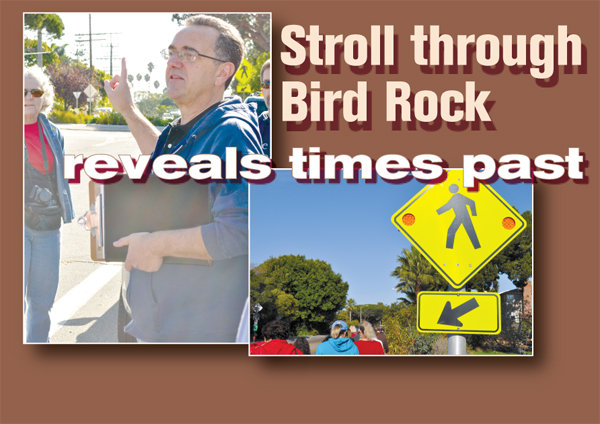
Community leader Joe LaCava and WalkSanDiego chairman Dave Schumacher led a neighborhood walk through Bird Rock on Dec. 17 as part of the organization’s ongoing series of historic walks throughout the city. Highlighting the area’s rich history — from the successful transformation of Bird Rock’s commercial district on La Jolla Boulevard to little-known facts about “Electric Avenue,” a single-track electric trolley line that ran parallel to the boulevard on La Jolla Hermosa Avenue — the tour provided guests with the ins and outs of recent and not-so-recent happenings in the community. Roundabout rundown Many Bird Rock residents probably remember when La Jolla Boulevard was not a charming, pedestrian-friendly commercial strip lined with thriving restaurants, cafes and businesses as it is today. Instead, it was a major five-lane thoroughfare that connected 20,000 commuters from south of Bird Rock to La Jolla Village, making it nearly impossible to cross safely, much less parallel park a vehicle to enjoy eateries, services or shopping in the area. Although the speed limit was posted at 25 mph, drivers clocked in as high as 45 mph, LaCava said. “That created two problems for us. One, it became a problem for the merchants because nobody stopped to even see there were merchants. We had a pretty good restaurant row I think, but nobody wanted to stop and try to parallel park when the cars are going 40, 45 mph, so the businesses were really suffering,” he said. “The other thing it did was divide us as a residential community. If you lived on one side of the boulevard, you drove to get to your friend’s on the other side because it was too dangerous to walk.” After years of community dialogue, a plan was finally developed to benefit residents and merchants alike. The plan focused on calming traffic on La Jolla Boulevard, as well as residential streets, with roundabouts and a median, improving the aesthetics and walkability of the area with landscaping and crosswalks, and putting Bird Rock merchants on the map — with parking spaces. “The key thing was that we got everybody to agree that there was a problem,” LaCava said. “Once we got people to realize there was a problem, people were more likely to be able to work together to solve the problem, and there was a big momentum moving forward.” The five-lane thoroughfare — including two southbound lanes, two northbound lanes and a turning lane — was narrowed into a two-lane boulevard with a landscaped median, five roundabouts and numerous crosswalks that invited pedestrians to stroll, shop and dine at the area’s quality shops and restaurants. “The real measure of success to me was when you could see 8-year-old kids be able to cross the street by themselves,” he said. “One of the other unintended, but pleasant surprises was the noise. Now you can have a pleasant conversation, which makes walking here more of a pleasant experience.” Though the move to alter the neighborhood’s makeup was not without controversy, the Bird Rock community today boasts nearly 100 successful businesses and restaurants on three and a half blocks of La Jolla Boulevard from Midway Avenue to Camino de la Costa. The tight-knit community continues to improve the area with ongoing refinements to the landscaping and upcoming installments of additional lighting in the spring. Rock down to ‘Electric Avenue’ Although many may have remembered the process of installing the roundabouts on La Jolla Boulevard, younger generations may not recall a time when the La Jolla bike path and La Jolla Hermosa Avenue, which run parallel to the boulevard, was actually a single-track streetcar line called “Electric Avenue” — or when the La Jolla United Methodist Church was actually an ornate passenger station. There were, in fact, two trains that came through Bird Rock. The first was a small railroad that extended to La Jolla from San Diego in 1894. The railroad ceased operation in 1918, and in the following year, the track was torn up and sold as scrap to Japan. The second track — which utilized the same right-of-way as the original track from 1924 to 1940 — was an electric railway, the first of its kind on the West Coast at the time. “San Diego has the distinction of being the first city on the West Coast to have electric streetcars, and the first city on the West Coast to get rid of the electric streetcars,” said Schumacher. Historic remnants of “Electric Avenue” can be found along La Jolla Hermosa Avenue still today. The name “Electric Avenue” is stamped into the curbs, track indentations can be found impressed in residential yards and the architecture of the station’s former waiting area platform can still be seen at La Jolla United Methodist Church. ‘Socially correct’ real estate Just a quick stroll down the road from Bird Rock’s merchant district is La Jolla Hermosa, a neighborhood inspired by John Spreckels — developer of Mission Beach — that dates back to 1924, Schumacher told guests on the walking tour. He said there were unique restrictions for property-owners in the area including the requirement that $8,000 must be spent on the construction of the home, properties could not contain chickens, goats or other farm animals — despite the fact that much of the surrounding area was farmland at the time — and all occupants, other than servants or employees, had to be Caucasian. An advertisement for the neighborhood in the San Diego Union in 1926 emphasized the neighborhood was built for the upper crust of society, dubbing it, “San Diego’s socially-correct spot to live.” For information about WalkSanDiego’s outings, visit www.walksandiego.org.


