


SANDAG holds Community Enhancement workshops to solicit ‘payback’ to residents for Express Lanes project
Por David Schwab | Reportero SDUN
Transportation officials came to the community at the second of two Community Enhancement workshops on the state Route 94 express-lane expansion to talk about possible secondary improvements from the freeway project, which could include expanding open space and bike lanes, to the creation of recreation “lids” over SR 94.

The SR 94 Express Lanes Project will connect Interstate 805 express lanes with Downtown by constructing two new lanes along SR 94, one in each direction, and a new direct connector between SR 94 and I-805, a release for the workshop said. The Express Lanes would accommodate new Bus Rapid Transit service in addition to carpools and vanpools traveling between South Bay and Downtown.
The Community Enhancement workshop held July 24 at the Sherman Heights Recreation Center drew people from South Park and greater Golden Hill who are not only concerned about the project’s traffic impacts to their neighborhoods, but also about the potential for creating new parks and recreational areas in a region of the city many see as lacking in open space.
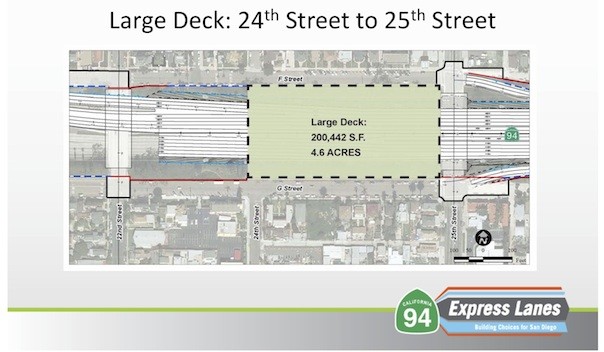
The most ambitious – and costly – proposed enhancement associated with the project is the idea of creating various-sized “lids” or “decks” over the freeway that could then be turfed and used for a variety of recreational purposes.
Lids over SR 94 were one of the issues landscape architect R. Brad Lewis came to discuss at the July 24 workshop. Following an opening overview presentation by Lewis and SANDAG traffic engineer Andrew Rice, Lewis conferred with Uptown residents in a small-group breakout session to discuss the freeway deck concept.
“It’s very similar to a bridge, the amount of concrete it takes to build, though it would have [a] little bit more depth,” Lewis said of the deck, which he noted has not yet been designed.
But how it is made, Lewis said, is not as important as how it could be used.
“How do you want to use this bridge?” he asked. “Is it just going to be a bunch of grass? Or is it going to be for other uses? That’s what you need to explore.”
Lewis said a freeway deck could be constructed in varying sizes from as large as 7 1/2 acres to as small as an acre and a half.
“If it’s just a park, a big grass area, you would have 3 1/2 feet of soil on top,” Lewis said. “It doesn’t have to be flat. Adding a big ‘super’ deck could have different levels.”
Lewis said a 7.5-acre super deck built over SR 94 between the bridges at 22nd and 25th streets could cost as much as $82 million and take a decade to complete. Alternately, he said a large, 4.6-acre deck could be constructed between 24th and 25th streets, a medium deck between 22nd and 24th streets or a smaller, 1.5-acre deck between 22nd and 23rd streets.

“That’s the vision, but any idea is on the table,” he said.
SANDAG currently has $15 million budgeted for enhancements, with the potential to seek other funding sources.
“Another idea is to create a pedestrian plaza – allowing no cars, just bikes – across 24th Street,” Lewis said, adding that it is up to the affected communities to decide how future enhancement money might be spent. He said funding could be spent all at once for something big, like a super deck, or dispersed among various small improvement projects.
City spokesperson Lynda Pfeifer said a freeway lid is one of many possible alternative community enhancements that could be derived from the SR 94 Express Lanes Project.
“The City will consider including one or more bridge decks in the Southeastern San Diego Community Plan Update, and the future draft Golden Hill Community Plan Update will include the bridge-deck concepts as a long-term, unfunded park improvement project,” Pfeifer said in an email.
On July 24, Rice said the workshop’s main purpose was to “talk about community enhancements,” which “is not the same as mitigation.” Potential enhancements are the portion of the freeway improvement project “where additional funds are made available to do things over and above the project and its mitigations,” he said.
“This is a unique opportunity to talk about enhancements,” Rice said.
Lewis said implemented projects stemming from the project, in a sense, are “payback” for traffic impacts. For some, payback could take the form of enhancing connectivity between neighborhoods.
“Highway 94, when it went in, split the communities of Golden Hill and Sherman Heights in half,” Lewis said. “Community enhancements from this project could help restore connectivity between those communities by repairing bridges at 22nd and 25th streets, improving bicycle and pedestrian circulation, putting in new, wider sidewalks, upgrading mass transit stations and adding more park and open space.”
For more information on the project visit keepsandiegomoving.com/SR94/.


