• en_US
  • es_MX
  • Sobre nosotros
miércoles, enero 14, 2026
Sin resultados
Ver todos los resultados

  • Historias destacadas
  • Noticias
  • Características
  • Opinión
  • Educación
  • Arte y entretenimiento
  • Deportes
  • Directorio de negocios
  • Asesoramiento de expertos
  • Bienes raíces
  • Historias destacadas
  • Noticias
  • Características
  • Opinión
  • Educación
  • Arte y entretenimiento
  • Deportes
  • Directorio de negocios
  • Asesoramiento de expertos
  • Bienes raíces
  • Historias destacadas
  • Noticias
  • Características
  • Opinión
  • Educación
  • Arte y entretenimiento
  • Deportes
  • Directorio de negocios
  • Asesoramiento de expertos
  • Bienes raíces
  • Historias destacadas
  • Noticias
  • Características
  • Opinión
  • Educación
  • Arte y entretenimiento
  • Deportes
  • Directorio de negocios
  • Asesoramiento de expertos
  • Bienes raíces
  • Historias destacadas
  • Noticias
  • Características
  • Opinión
  • Educación
  • Arte y entretenimiento
  • Deportes
  • Directorio de negocios
  • Asesoramiento de expertos
  • Bienes raíces
  • Historias destacadas
  • Noticias
  • Características
  • Opinión
  • Educación
  • Arte y entretenimiento
  • Deportes
  • Directorio de negocios
  • Asesoramiento de expertos
  • Bienes raíces
  • Historias destacadas
  • Noticias
  • Características
  • Opinión
  • Educación
  • Arte y entretenimiento
  • Deportes
  • Directorio de negocios
  • Asesoramiento de expertos
  • Bienes raíces
  • Historias destacadas
  • Noticias
  • Características
  • Opinión
  • Educación
  • Arte y entretenimiento
  • Deportes
  • Directorio de negocios
  • Asesoramiento de expertos
  • Bienes raíces
  • Historias destacadas
  • Noticias
  • Características
  • Opinión
  • Educación
  • Arte y entretenimiento
  • Deportes
  • Directorio de negocios
  • Asesoramiento de expertos
  • Bienes raíces
  • Publicaciones
  • Directorio de negocios
  • Sobre nosotros
  • Contáctenos
  • Escritores del personal
  • Suscripciones/Soporte
  • Historias destacadas
  • Noticias
  • Características
  • Opinión
  • Educación
  • Arte y entretenimiento
  • Deportes
  • Directorio de negocios
  • Asesoramiento de expertos
  • Bienes raíces
  • Historias destacadas
  • Noticias
  • Características
  • Opinión
  • Educación
  • Arte y entretenimiento
  • Deportes
  • Directorio de negocios
  • Asesoramiento de expertos
  • Bienes raíces
  • Historias destacadas
  • Noticias
  • Características
  • Opinión
  • Educación
  • Arte y entretenimiento
  • Deportes
  • Directorio de negocios
  • Asesoramiento de expertos
  • Bienes raíces
  • Historias destacadas
  • Noticias
  • Características
  • Opinión
  • Educación
  • Arte y entretenimiento
  • Deportes
  • Directorio de negocios
  • Asesoramiento de expertos
  • Bienes raíces
  • Historias destacadas
  • Noticias
  • Características
  • Opinión
  • Educación
  • Arte y entretenimiento
  • Deportes
  • Directorio de negocios
  • Asesoramiento de expertos
  • Bienes raíces
  • Historias destacadas
  • Noticias
  • Características
  • Opinión
  • Educación
  • Arte y entretenimiento
  • Deportes
  • Directorio de negocios
  • Asesoramiento de expertos
  • Bienes raíces
  • Historias destacadas
  • Noticias
  • Características
  • Opinión
  • Educación
  • Arte y entretenimiento
  • Deportes
  • Directorio de negocios
  • Asesoramiento de expertos
  • Bienes raíces
  • Historias destacadas
  • Noticias
  • Características
  • Opinión
  • Educación
  • Arte y entretenimiento
  • Deportes
  • Directorio de negocios
  • Asesoramiento de expertos
  • Bienes raíces
  • Historias destacadas
  • Noticias
  • Características
  • Opinión
  • Educación
  • Arte y entretenimiento
  • Deportes
  • Directorio de negocios
  • Asesoramiento de expertos
  • Bienes raíces
  • Informe de noticias
SDNews.com
Casa Características

Single-celled organisms turn sand green

Tech por tecnología
marzo 21, 2009
en Características, Noticias de La Jolla Village
Tiempo de leer: 3 minutos de lectura
0 0
A A
0
Single-celled organisms turn sand green
0
COMPARTE
54
PUNTOS DE VISTA
Single-celled organisms turn sand green

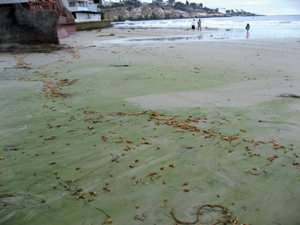
Those of us who regularly ply the beach at La Jolla Shores may wonder what the patches or swaths of green sand are all about. Not a St. Patrick’s Day stunt gone permanently awry, the verdant coating is made up of billions and billions of microorganisms belonging to the genus Euglena. A member of the protista, a catchall kingdom for organisms that aren’t animals, plants or fungi, the single-celled Euglena is a freshwater organism oddly found in a saltwater environment. It manages to survive by tolerating brackish conditions (wherein freshwater runoff mixes with ocean water) like those found at the Shores. The green presentation appears compliments of the cell’s chloroplast, the same organelle found in plants and known as the root, so to speak, of photosynthesis, the method of garnering food from sunlight. Not all Euglena species photosynthesize, but the ones that do trace their origins to an auspicious interaction with a single-celled alga. Simply put, a Euglena engulfed the alga and, instead of digesting the foreign body, somehow incorporated and used it as another avenue for gaining nutrition. I say another because a Euglena can engulf nutrient particles in the sand for nutrition as well. Since a Euglena cell reproduces by splitting in two (fission), only one Euglena cell and its permanent green guest would have been required to populate this new, evolutionary line. A Euglena enjoys a peripatetic lifestyle thanks to its whiplike tail, the flagellum, which is anchored into the cell’s polar end. Being able-bodied is key because a Euglena’s life is closely connected to tidal ebb and flow. Unlike the tides, though, a Euglena’s rhythm is vertical through the sand substrate. During daytime, when low tide exposes sand to air, millions of Euglena cells head to the sand’s surface to absorb the sun’s rays. About a half hour before the first wave from an incoming tide sweeps across the sand, a portion of a Euglena population begins migrating downward so the green is less intense. The many lollygagger Euglena cells caught on the surface are washed higher onto the beach. As the wave retreats, the cells now transported higher up the beach percolate into the sand. Michael Kingston, environmental biologist at Elon University, studied Euglena viridis, the species found at La Jolla Shores, and discovered that when it comes to sunlight, like dessert, too much of a good thing isn’t better. Kingston said, “We found that really bright sunlight inhibits photosynthesis. The highest photosynthetic rate is found at about 60 percent sunlight. Below about 4 millimeters [in the sand] there is no light, so the cells adjust to the strength of the sunlight by photosynthesizing from the surface to three millimeters.” Not surprisingly, then, a Euglena’s movement in sand and its photosynthetic machinery are intimately linked. Within a Euglena’s body lies a circular, red body called a light spot, or even less accurately an eye spot, that faces one side of the cell. Both names are misnomers because the red spot actually shades the light. So really, it’s a shade spot. A light-detecting organ exists as well but it’s near the base of the flagellum. The shade spot and the light organ partner to influence whether a Euglena moves toward the light or away from it. As the whiplike tail propels the Euglena forward, the cell spins in rotation, not unlike the way a thrown football travels from point A to point B while simultaneously spinning. Because a Euglena cell is constantly rotating, the shade spot alternates being struck by light and shaded from light. Incoming information from the periodic, split-second shading determines whether Euglena angles toward or away from the light. When there’s not enough light to photosynthesize, a Euglena population moves deeper into the sand to search out nutrient particles. Kingston said, “Euglena is typically found where there is higher organic output, such as runoff locations where organic compounds such as those from fertilizers [ammonia nitrates, et cetera] and sewage wash into the ocean. In California, I look for cliffs and runoff to find Euglena. It is the seepage of freshwater and its extra nutrient content moving onto the beach and into the ocean that make for an ideal Euglena habitat.” These conditions have Kingston dreaming that in the future Euglena cells may be used like canaries in a coal mine to track groundwater flow. Know that pollution doesn’t only wash from the sand’s surface into the ocean but also seeps up from under the sand and makes its way into the ocean. Freshwater from the tide washing in and out may dilute low-level, nonpoint sources of pollution so they don’t show up on a seepage meter. Employing a Euglena assay may better indicate pollution before it fouls the ocean because low concentrations of enriched freshwater are all that’s necessary for a Euglena population to bloom. This contrasts with larger-scale flows from rain runoff events needed by seepage meters to read pollution levels. Consequently, measuring Euglena concentrations may have merit as a superior way to monitor water quality. So once again, it’s good to be green. — Judith Lea Garfield, biologist and underwater photographer, has authored two natural history books about the underwater park off La Jolla Cove and La Jolla Shores. www.judith.garfield.org. Questions, comments or suggestions? Email [email protected].

Publicación anterior

Church should abide the same rules

Publicación siguiente

Nazarene takes a swing at GSAC with early hot streak

Tech

tecnología

Relacionados Publicaciones

Single-celled organisms turn sand green
Beach & Bay Press - Noticias

I Love A Clean San Diego colocará 200 contenedores temporales a lo largo de las playas

por Personal de SDNEWS
26 de mayo de 2023
a crow sits in one of the trees overlooking allen canyon, photo by cynthia g. robertson
Características

Allen Canyon: una caminata verde a través de la historia de Mission Hills

por cynthia robertson
5 de mayo de 2023
balcony cortez
Noticias del centro

Madre honoraria de Downtown celebra 60 años de matrimonio

por Dibujó Sitton
5 de mayo de 2023
Single-celled organisms turn sand green
Beach & Bay Press - Noticias

Figura del asesinato de Garett Berki en 2011 fue encontrada asesinada en una fiesta

por Neal Putnam
4 de mayo de 2023
little italy sign
Noticias del centro

Cena vegana en Little Italy por el Día de la Tierra

por Chris Gómez
16 de abril de 2023
Single-celled organisms turn sand green
Características

Un homenaje a Kensington: un estudio de caso de acupuntura urbana

por PERSONAL DE SDNEWS
15 de abril de 2023
Single-celled organisms turn sand green
Noticias del centro

La calidad es el objetivo principal del histórico Teatro Spreckels

por sandee willhoit
13 de abril de 2023
Single-celled organisms turn sand green
Características

Bridle Trail: un paseo por el lado salvaje de la carretera 163

por cynthia robertson
11 de abril de 2023
Publicación siguiente
Single-celled organisms turn sand green

Nazarene takes a swing at GSAC with early hot streak

[bloque de inserción = "1"]
  • Directorio de negocios
  • Sobre nosotros
  • Contáctenos
  • Escritores del personal
  • Suscripciones/Soporte
  • Publicaciones
  • Informe de noticias

CONECTAR + COMPARTIR

© Derechos de autor 2023 SDNews.com Política de privacidad

¡Bienvenido de nuevo!

Inicie sesión en su cuenta a continuación

¿Contraseña olvidada?

Recupera tu contraseña

Ingrese su nombre de usuario o dirección de correo electrónico para restablecer su contraseña.

Iniciar sesión
Sin resultados
Ver todos los resultados
  • en_US
  • es_MX
  • Informe de noticias

© Derechos de autor 2023 SDNews.com Política de privacidad