


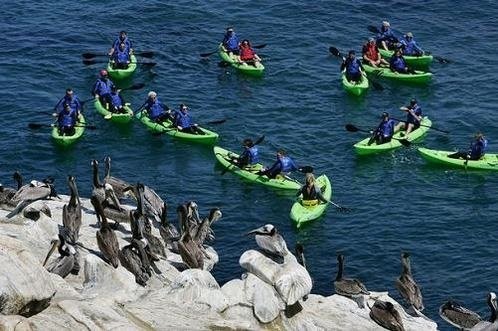
Neighbors concerned about sidewalk overcrowding, street sand deposition, traffic congestion and parking problems associated with kayak rentals weighed in at La Jolla Shores Association’s (LJSA’s) September meeting, saying they want to be part of the solution.
A new RFP (request for proposals) process is presently under way between five existing Shores kayak concessionaires and lifeguards and the city to establish terms for renewal of three-year contracts allowing the concessionaires to run beach kayak tours.
Concessionaires have a maximum of 54 tour slots (up to ten kayaks per tour) for a maximum of 540 kayak rentals divided among them per day. There are also other kayak businesses unregulated by the RFP that rent kayaks to customers who transport them on their own.
San Diego Lifeguard Lt. Rich Stropky told Shores Association board members and a room-size audience that the existing RFP agreement with kayak concessionaires terminates next spring on April 1. Stropky said the RFP process requires concessionaires to provide a package of information about their operations to the city for review.
“The city and lifeguards get feedback from the community,” Stropky said, “which makes the whole process better for concessionaires and the community, with safety at the top of our (priority) list.”
Several Shores residents saw it differently. Some argued the water sport has grown exponentially over the years, diminishing the community’s quality of life as well as presenting an ongoing threat to the safety of ocean swimmers.
One resident who spoke out commented that “commercialization has gone bonkers” with kayak proliferation. Wayne Thomas complained about the duration of the seemingly too-long kayak RFP agreements, noting that “we, the residents, have to live with that.”
Attorney Jim Mittermiller, a swimmer, said he no longer feels safe in the ocean because of the preponderance of kayaks. “I like to swim from the Cove to the Beach Club,” Mittermiller said, “and I’ve been hit by kayaks ten times — there’s too many of them. There’s an armada of these things out there.”
In response to Mittermiller’s comments, LJSA board member Ray Higgins commented that “individuals in the water have rights” that he pointed out supersede the rights of vessels.
“There are a lot of people (kayakers) who are underqualified to be out there,” Higgins said.
Not everyone at the meeting was negative about kayak operations. Norm Blumenthal, who likes to run on the Shores beach, said he “couldn’t believe how hard” kayak concessionaires work, noting he didn’t mind sharing space with them because they have their place in the recreational mix.
Blumenthal said he felt that unregulated users, like paddleboarders, accounted for much of the problem with congestion caused by water recreationists, especially during busy summer weekends.
Operating conditions, Stropky said, have gradually improved with every succeeding kayak RFP, which is now in its third go-round.
LJSA chair Tim Lucas noted things have improved with kayaks at the Shores over time.
“Ten years ago, we had more than 15 unregulated kayak vendors,” he noted.
The kayak RFP money currently goes into the city’s general fund. Some at the meeting said the desire to have at least some of that money returned and used for improvements at Kellogg Park remains a sore point.
LJSA will revisit the issue at a later date once the concessionaires have had an opportunity to submit their applications to the city and lifeguards.


