


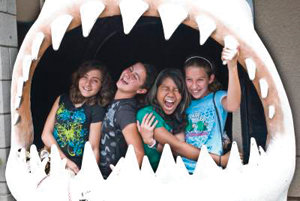
For those who can’t dip their toes into the ocean without hearing the “Jaws” theme, Shark Week at the Birch Aquarium at Scripps Institution of Oceanography may not sound like an ideal excursion. But Scripps education director Kristin Evans explained why the species are sorely misunderstood, and how Shark Week hopes to subvert harmful stereotypes. “A lot of people think sharks are very aggressive, bloodthirsty hunters, and that’s really not the truth at all,” Evans said. “Shark Week gives people an opportunity to learn how sharks are an essential part of the ocean community, while hopefully realizing that fearing sharks is not necessarily beneficial to their own survival or to that of sharks in the wild.” Shark Week runs from July 17 to 23 from 11 a.m. to 3 p.m. daily. More than 10 species of sharks, including local species like swell sharks, horn sharks and leopard sharks will occupy “touch tanks” as naturalists invite guests to get up close and personal. “They’re juvenile sharks, so they’re much smaller than the ones you would usually see in the water or other display tanks,” Evans said. Science Exploration Adventure (SEA) Days on July 17 marks the busiest day of activities for Shark Week, Evans said. Hourly shark presentations educate about preservation, and a Scripps doctorate student will speak about sharks and research at noon. “Shark Bites,” an activity station, allows visitors to learn about shark jaws and diets. Another station focuses on the challenges faced by leopard sharks — common to the waters around the San Diego area — and extra tables display shark eggs, skeletons and other hands-on educational activities. Stories and craft times will also be held throughout the day. Current threats to shark populations include severe overfishing, ocean pollution and killing for sport, Evans said. “Some of this stems from fear of sharks and what they represent, myths propagated by stories and movies, and some is a simple misunderstanding of biology and reproduction,” she added. “But sharks play a major role in ocean ecology and are essential to what an ecosystem needs to be healthy. As large predators, their populations don’t recover as quickly when they start to decline.” For those who fear what lies beneath, Evans offers a few simple words of wisdom. “It’s always wise to be aware of your environment on land or in the water and to know what’s sharing that space with you,” she said. “It’s also wise to realize that most of what is there is more fearful of us than we are of them.” Evans repeated an analogy she often uses with children who visit the aquarium. “When we’re in the ocean, we’re visiting someone’s home,” she said. “Just like when you’re at a neighbor’s house, if you show respect and treat it kindly, you’ll be very welcome there.” Sharks have been around for about 400 million years, Evans said. “The basic design hasn’t changed, although many species have evolved. It’s amazing that essentially the basic features are the same.” Many of those features, Evans added, have inspired advancements that are beneficial to humans, including sharkskin-inspired wetsuits and swimsuits designed to improve hydrodynamics. “This is a great way for families to come learn about sharks and how to help preserve them locally and everywhere,” Evans said. “If the thought of sharks makes the hairs raise on the back of your neck, this is a great way to slowly overcome some of those fears in a very safe and fun way.” All Shark Week activities are included with Birch Aquarium admission, which is $18 for adults, $9 for seniors over age 60, $8.50 for youths ages three to 17, and free for children under two. The aquarium, located at 2300 Expedition Way, is open from 9 a.m. to 5 p.m. daily. Dive shows in the two-story kelp forest tank: • Saturday, July 17, 2 p.m. • Sunday, July 18, 10:30 a.m. • Tuesday, July 20, 12:30 p.m. • Thursday, July 22, 12:30 p.m.


