


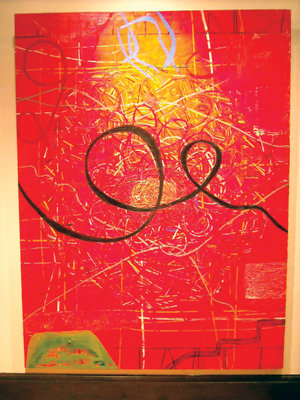
The Antheneaum Music & Arts Library at 1008 Wall St. is a warm, comfortable and inviting place. It’s in an old building with high ceilings, large interior wooden roof beams and tall arched windows. There are shelves of art books, magazines and some comfortable places to sit. It’s a perfect and pleasant destination for an art gallery visit. There was an opportunity for just such a pleasant visit to the Athenaeum on May 22. It was the opening of an exhibit of paintings by Ellen Salk, who is married to Peter Salk, MD, the son of Jonas Salk, the discoverer of the polio vaccine. There were six large 6-foot by 4-foot paintings and five smaller 3-foot by 3-foot pencil and oil stick geometric renderings on display. Upon entering the gallery one was immediately drawn to Salk’s bright red paintings, but the ones in basic white slowly garnered more attention as the night wore on. The basic theme of Salk’s abstract work is loops, swirls, curly Qs, alpha helixes and infinity signs which seem to swirl around as in a whirlpool. The paintings are soft, warm, and non-threatening but seem to lack a certain jolt, challenge or artistic precision in the brush work. Salk calls them “dense and driving and … at once minimal and complex.” She said that they are the result of three years of work and are based upon the ecstatic music, song and circular dances of the Shaker religion. The Shaker sect is an offshoot of the mid-18th century English Quakers. It was brought to American by Ann Lee in 1174 and is characterized by a charismatic worship style involving dances, marches and singing which lead the participants to states of trembling rapture. Apparently Salk was trying to capture some of the essence of the Shaker dances and their ecstasy in her work. Of her work Salk said, “The life of a painter has provided me with the opportunity both to explore and to express my experience of being human in a complex and unknowable world, where certain things none the less appear to reflect great beauty and meaning.” Perhaps the helices and loops of Salk’s paintings reflect the RNA/DNA molecules and a scientific understanding of life which can create a certain tension when contrasted with a religious experience of life as in the Shaker whirling and trembling, and maybe this is the deeper meaning of her work. Roman Pearah, a Carlsbad resident, stopped by the gallery after dinner in the Village with his girlfriend. “I don’t really like Salk’s paintings that much,” he said. “Real art is unforgettable. It touches you. Real art makes you queasy. It hits you in the gut. These paintings just don’t do it for me.” But Casey Jones, an operations specialist at a biotech firm, had a more favorable reaction. “I like them. They remind me of Jackson Pollack,” she said. Jones came to the show because she was interested in how one of Pablo Picasso’s mistresses, Francois Gilot, had later married Jonas Salk. Through a sense of roundabout connection, this made her interested in Ellen Salk, who she felt might lead her back to Picasso. Jones thought that the paintings were, “very feminine, like the curls in a woman’s hair.” She said she felt a “flow of femininity in the curls and swirls of the paintings” which made her “appreciate her own femininity.” Rene Arsty, a local artist who is a Village regular, also liked the paintings, which she described as “colorful, comfortable and warm.” The exhibit will be on display until June 19. Gallery hours are Tuesdays through Saturdays, 10 a.m. to 5:30 p.m. It is open late on Wednesdays until 8:30 p.m. and closed Sundays and Mondays.


