


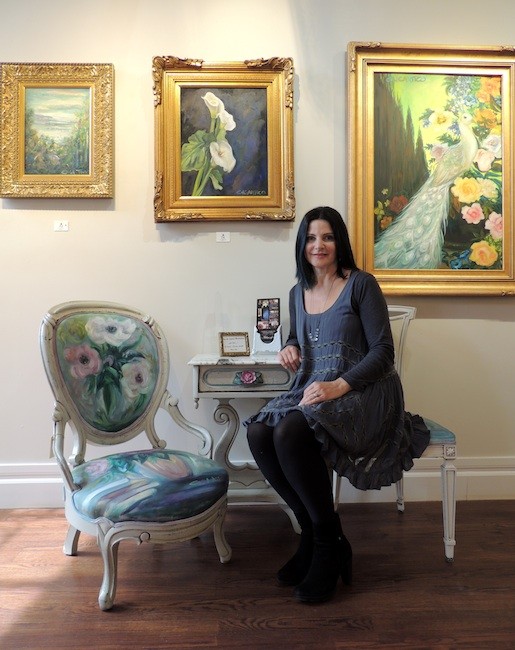
Mission Hills artist uses her tetrachromacy – or fourth color receptor – as avenue to teaching
Por Cynthia Robertson | Reportero SDUN
Concetta Antico, owner of The Salon of Art in Mission Hills, has a somewhat different view of the world.

Born with a condition known as tetrachromacy – she has four different types of cone cells in the eye that process color, rather than the typical three – Antico paints a world of color that most people simply cannot see.
The artwork on the walls of Antico’s studio draws the viewer in for the vibrancy and palette of colors. At first, in her more than 20 years of painting as a contemporary impressionist, Antico thought she simply preferred to paint in more colors than most artists.
For Antico, being a tetrachromat is a blessing, not a burden. She won many awards for her art while she was in elementary school. “I was obsessed with art, and particularly painting and the impressionist masters, from a very early age,” she said. “My mother told me when I was just a little girl that I would be an artist and an art teacher one day. I have never forgotten that.”
Her mother was right. Antico has become a respected artist whose work is a favorite of art collectors. In 1995, she created her art school, focusing her methods of fine oil painting instruction in the classical atelier tradition. Students paint an object exactly as it appears to them on a one-to-one scale.
“I teach my students how to make a beautiful painting in just three and a half hours,” she said.
Antico did not discover that she had a condition in her eyes with an actual medical name until just recently. One afternoon, Dr. Wendy Martin walked into Antico’s salon thinking it was the shop next door. Martin saw that Antico was about to begin an afternoon class.
“She graciously ushered me out the door with a brochure of her class offerings,” Martin said. “Before I knew it, I was taking oil painting classes for the first time in my life.”
Martin became intrigued with Antico’s special inside look at color. She told the story of when Antico was a small child and asked to paint a fence along with other children to keep them from being underfoot. “Unlike the other children who quickly grew bored with the exercise, she was fascinated, and when she reached the last post, went back and started over again,” Martin said.
“She could see the colors of water, and she could distinguish an exquisite palette as the wood went from wet to dry. She literally could see another world that her wee playmates could not,” Martin said.
In another example, this time in in the studio, Martin and Antico looked up at a shadow that was cast on the ceiling from a floor light, and Antico asked, “See the pink? The green? The pale purple?”

Martin, however, said she could only see a slightly grey shadow.
“Where you and I can see about 1 million hues, or color, Concetta can see 100 million,” Martin said.
Whether she is painting outside during a plein air session or in class at the studio, Antico will always see colors that her students do not.
“Once she puts those brush strokes of color on the canvas, it makes intrinsic sense. It adds an unexpected contrast, a splash, a punctuation mark of sorts that makes her work unique and complete,” Martin said.
Statistics vary, yet studies have shown that approximately two percent of females have the additional photoreceptor. Males however, have a lower rate of a fourth receptor, and are often more likely colorblind, which is also related to the number of color receptors in the eye.
“I feel a great joy when I paint, able to recreate the beauty that I see,” Antico said. “It is rewarding to be able to share my gift. I have taught over 12,000 people to paint.”
Because she is able to resolve and mix colors and values easily, Antico can paint quickly, too. She recently completed a live demonstration during which she painted a 30-by-36-inch still life for the audience in less than four hours.
“They were as astounded as they were mesmerized, as they watched the process and the painting unfold,” she said.
Favorite subjects for Antico are things of nature, from flowers and animals to clouds and oceans. Primarily, she said, because of what only a few can see. “They have more color than other things on this earth,” she said.
Ironically, her fourth receptor did not pass along genetically to her daughter Ava, who instead is colorblind like her father.
“She paints in my programs,” Antico said. “She is great. She also is in love with drawing.”
To join the ever-growing circle of collectors and students of Antico, visit the Mission Hills salon at 1920 Fort Stockton Dr. For more information, visit thesalonofart.com or call 858-344-6897.


