


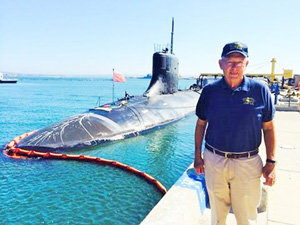
Capt. Charlie MacVean, former submarine commanding officer and Point Loma resident, will present the next lecture in a series on Point Loma’s military past on Thursday, Jan. 14, at Point Loma Assembly, 3035 Talbot St., from 5:30 to 7 p.m. A $10 donation will be accepted at the door. Pizza, salad and refreshments will be served.
The event is co-hosted by Point Loma Assembly and La Playa Trail Association.
MacVean was born and raised in Ridgewood, N.J. He received his naval commission through the NROTC program at Dartmouth College and graduated in 1959. He later earned a Ph.D. in nuclear science and engineering at Cornell University. MacVean’s 16 years of sea duty included qualification in submarine command, and he served aboard three boats before commanding Seawolf (SSN-575) at the height of the Cold War. Seawolf was the second nuclear sub ever built; five boats in all have been so commissioned.
MacVean stresses the importance of the work in the country’s defense just a half-mile from his home. “Nowhere else,” he said, “can you find a locale such as Point Loma, combining a Navy organization with seagoing assets dedicated to deep ocean research and exploration. “Beyond Point Loma,” he continued, “was the intellectual capital represented by the University of California San Diego, University of San Diego and San Diego State University and, finally, the gathering of nearby pioneering companies vested in marine technology. I’ve been to every sub base, and there’s none like Point Loma in technique and technology.” But what was life like living in the strange environment of an attack submarine? “It boils down to trust. How do you go to sleep if you don’t trust the guy behind you to turn the valve at the right time?
“We were blessed with wonderful people around us,” MacVean recalled. “I was always trustful that the people who were awake would do the right thing. You knew the training they went through. We relied on a trust up and down the sub force not equal to anywhere else in the world. And we took care of each other, at sea and of families at home.”


