


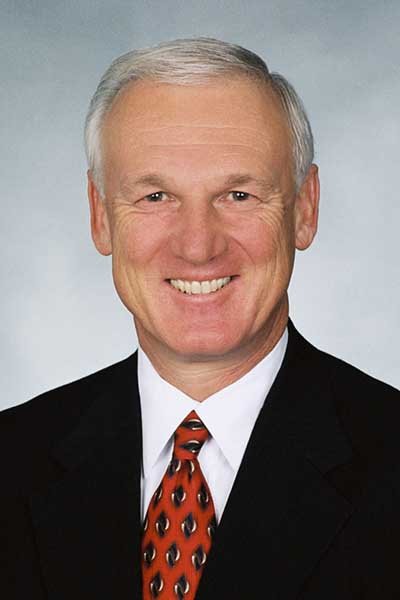
Holding the county out as a model of efficiency, Supervisor Ron Roberts spoke on the local government’s proven record of fiscal success, touching on a variety of themes at the La Jolla Community Center on June 20. Introducing Roberts, community center board chairman Glen Rasmussen spoke about Roberts’ background — a native San Diegan and SDSU undergraduate who earned his master’s degree in architecture from UC Berkeley before embarking on a successful 20-year architectural career and serving on both the City Council and County Board of Supervisors. “Roberts is known for his fiscal discipline and for his focus on at-risk youth, senior issues, long-range planning, health and his transportation leadership, including the proposed extension of the trolley from Old Town to UCSD and UTC,” said Rasmussen. Roberts, whose Fourth Supervisorial District, previously administered by Pam Slater-Price, now includes La Jolla since the 2010 census redistricting, said the news he had to share about the county was “largely good.” That good news, however, has not been in the news much, he said, because, “We’re not in (financial) crisis.” The event was part of La Jolla Community Center’s ongoing Distinguished Speaker Series, which has featured high-profile leaders like Qualcomm founder Irwin Jacobs and world-renowned Scripps oceanographer Walter Munk.?The center, formerly a senior center, is being transformed into a multi-dimensional, full-service adult recreation facility with a wide variety of programming. “A lot of people know who the supervisors are,” said Roberts during his hour-long speech. But, he added, “Hardly anybody knows what the county is.” Roberts said San Diego County, which includes 18 cities and a large unincorporated area, is 4,200 square miles, which, he said, “is bigger than two states — Rhode Island and Delaware — and whose $5 billion budget this year is actually bigger than 13 or 14 states’ budgets.” From a population standpoint, Roberts said, San Diego has more people than 20 states. Despite its immensity, the county has proven to be manageable given supervisors’ fiscal restraint. “We have the highest credit rating of any local government agency in the country,” said Roberts, noting that the Board of Supervisors “is very fiscally responsible. That doesn’t mean we don’t spend, but that we’re careful.” Roberts said the overriding fiscal directive of supervisors during his tenure, unlike state government, has been to “never take one-time money and start new programs with it.” “You [as a supervisor] want to start something — you figure out where the funds are coming from,” said Roberts of the county’s philosophy on fiscal management. The county, said Roberts, took an entirely different approach — privatizing many essential services — which has proven to be practical, as well as fiscally sound, and the answer to resolving some revenue shortages. He referenced the county’s privatizing of its trash system as a prime example. “It was unheard of,” Roberts said of privatizing landfill and trash systems. “But we put the whole thing [which was losing $40 million a year] up for sale and we sold the system for $182 million, and then [the county] got money for it from tipping [user] fees and the landfills went on the tax rolls and we got tax money for them. Does it get any better, selling something to someone and then saying, ‘Send me rent payments in the form of taxes?’” After his speech, Roberts fielded audience questions. Board member Sherry Ahern asked why the city couldn’t emulate the county’s fiscal approach. “It’s a different political environment,” he said. “We’ll never tell them what to do. But if they want to learn from what we’re doing …” Asked his stance on Irwin Jacob’s controversial plan to eliminate cars in much of Balboa Park’s Prado area and build a parking structure elsewhere instead, Roberts said, “The idea of clearing the cars out of that part of the park is a good idea.” He also characterized a proposal to close the park’s Laurel Street Bridge as “a mistake of the highest order.” Roberts also discussed at length his visionary plan for redeveloping the Embarcadero area surrounding the County Administration Center on the downtown waterfront. He told of plans to turn it into a huge pedestrian park with grass and other landscaping and a cascading series of water fountains that he said could be “an active space where you could go and enjoy yourself.” For more on the La Jolla Community Center’s Distinguished Speaker Series, visit www.rifordcenter.org.


