


“The Wildest Dream”
Directed by Anthony Geffen
Escrito por Mark Halliley
Protagonizada por: Liam Neeson, Natasha Richardson, Ralph Fiennes, Alan Rickman and Conrad Ankers
Rating: 0
A sacred oath has been broken: I walked out on a movie.
Before Wednesday morning’s screening of “Animal Kingdom” (alas, not an expose of an S&M relationship between Marlin Perkins and Jim Fowler, but a surprisingly effective Australian take on “Goodfellas”), a colleague asked if the next day’s movie was a documentary or narrative feature.
“The Wildest Dream” was the last film Natasha Richardson worked on. There was also a threatened “Schindler’s List” reunion of sorts to contend with: Both Liam Neeson and Ralph Fiennes’ names appear on the poster. (Alan Rickman and Hugh Dancy also receive billing.) Surely with all this star power, I thought, the film had to be a narrative account of the life of George Mallory, the first man to scale Mount Everest. (Either that or it’s an expensively-voiced cartoon reenactment from Dreamworks Animation.) When told that it was indeed a documentary I joined my fellow critic in letting out an exasperated sigh. Enough of these well-intentioned, inexpensive to make, hand-held video soapboxes that don’t lose their impact on the small screen: Show me a story!
“The Wildest Dream” contains no political agenda. It’s bankrolled by National Geographic so expect what Pauline Kael dubbed “a coffee table movie.” There are only two ways to properly exhibit a film of this nature: IMAX or HDTV. “Wildest” is being given the giant screen treatment in other parts of the world, but National Geographic was unable to attract one of San Diego’s two IMAX houses. Being too proud to let their hard work go straight to satellite, the film will play in 35mm at Landmark’s Hillcrest Cinemas starting on Aug. 20.
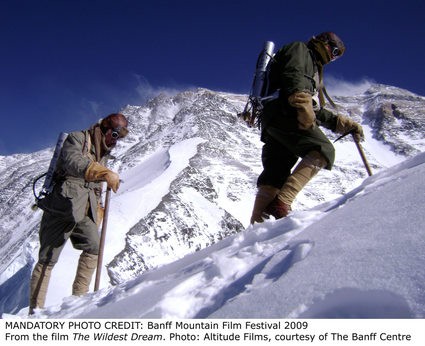
The opening reality TV dramatization of mountain climber Conrad Anker’s 1999 discovery of Mallory’s remains is as primitive as the pioneer mountaineer’s climbing gear. Frozen in the snow for 75 years, Mallory’s femur appears to have been crafted out of polyvinyl chloride. And I had to chuckle at Anker’s stiff, over-rehearsed on-camera interview sequences.
For a brief moment there was hope: A long, glorious serpentine aerial shot whisks us from the base of the mountain quite literally to the top of the world. Not long after, tedium dropped anchor as Anker attempts to recreate Mallory’s legendary climb. Suddenly I’m back in seventh grade geography class fighting valiantly to remain conscious during an endless educational short. Those films at least had bland narrators to help lull you off to lullaby land. Anker’s pretty boy charm (Robert Redford called and wants his jaw back) and colossal ego are too much to bear. Forget about the fact that he has a helicopter and camera crew following his every step up Everest; in Anker’s eyes he is Mallory reincarnate, not just the mountain climbing equivalent of an Elvis impersonator.
In my youth, walking out on a film, no matter how bad, was bad form. I harbor enough guilt for no longer sticking it out through closing credit sequences. Were I to have followed my gut and vamoosed a third of the way through “Eat, Pray, Love,” I’d have been deprived the best five minutes of acting committed to film this year. (Richard Jenkins, not Julia Roberts.)
The only time I ever asked for my money back was when the quality of the presentation wasn’t up to par. There were many times when poor projection or sound forced me to bolt, but I never requested a refund based on the quality of the film. While managing a suburban art house in Chicago, I would frequently be asked by patrons for their money back after watching an entire feature. My rule of thumb was simple: If you didn’t like a movie and walked after 10 or 15 minutes your money was cheerfully refunded. Anything after that and you had better provide proof that every member of your family was about to undergo surgery before so much as a penny would pass hands.
Even if I wanted to, nowadays I can no longer ask for my money back. Knowing that “The Wildest Dream” was destined to be a nightmare, why did I even bother? In the words of a great man, “Because it’s there.” You never know when you’re going to find a good movie. Well, almost never. In this case the trick was never showing up in the first place.


