


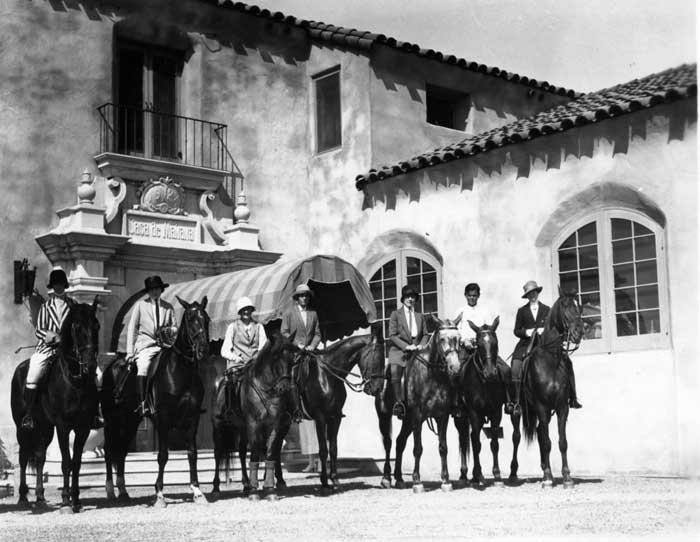
A look through early La Jolla photographs reveals that there once were a lot of horses on the streets. Horses tethered together on hitching posts and rails on Prospect Street, horses being ridden by solitary riders, horses pulling wagons and carriages around town. This was in the early days of the late 19th and early 20th centuries, when the streets were dirt paths and maps showed riding trails through neighborhoods now populated with houses and condominiums. La Jollans loved horses. When pioneer George Heald built the first home here in 1887 at Silverado Street and Exchange Place, he built his horse barn first to shelter the animals before building his own house. Providing water for horses developed into a community beautification program in 1909 when an old wood trough at Girard and Prospect was replaced by an ornamental stone trough canopied by an arbor covered with bougainvillea. One of the most beloved and admired horses in early La Jolla was a sorrel named Tramp, owned by a black man born in Virginia and raised in Kentucky, where his love for fine steeds and race horses was nurtured. Postmaster Nathan Rannells, also a proud horseman in La Jolla in the early years, said of Tramp’s owner: “When one talked horses to him, one talked as one expert to another. He had a way with horses, and the wildest ones gentled quickly under his kind but firm hand.” Another regular sight in the early 1900s was a produce delivery wagon pulled by the two horses owned by the La Jolla character familiarly known as Bill Tom, the Chinaman. An unruly team of runaway horses is recorded in La Jolla history, as well, when a wagon delivering a load of fresh meat overturned on the steep Biological Grade (now La Jolla Shores Drive) into town. When the wagon’s kingbolt failed to release, the team ran pell-mell into La Jolla pulling just the front wheels. The team was tamed down and unhitched with the incident ending happily. In one of the La Jolla Historical Society’s oral histories, Franklin Smith, growing up here as a child also in the early 1900s, recalled horse-drawn wagons regularly coming and going around the cottage he lived in on Roslyn Lane. The wagons delivered vegetables and fireplace wood. The horses wore straw hats as they pulled their loads. As La Jolla grew up, horses became more a matter of sport and riding academies. The Bishop’s School girls had formal riding classes. When the Casa de Manana opened in 1924 as a luxury resort hotel, guest amenities included fine horses available for riding around the beaches and up and down the hills. Sybil Darlington, the New York socialite who came to live in La Jolla around the same time period and was an accomplished rider, could often been seen galloping around the sand dunes (Darlington quickly made it known, too, that she had learned to shoot with Annie Oakley). By 1931, La Jolla equine sophistication had grown sufficiently to encourage a new riding academy to be built at the junction of Torrey Pines and Ardath roads. Designed by architect Herbert Mann, it featured practice and show rings, a club house with 30 box stalls and locker rooms, as well as a second-story apartment for the proprietor, Miss Jean Moore. The Riding Academy operated until 1948, when the property was sold and it was turned into a new facility operated as Rancho del Charro. The same year witnessed the arrival of another horse fancier in La Jolla — developer and financier William Black who started Blackhouse Farms beyond the Shores with his own line of thoroughbreds. But that’s another horse story. — Carol Olten is the historian of the La Jolla Historical Society


