


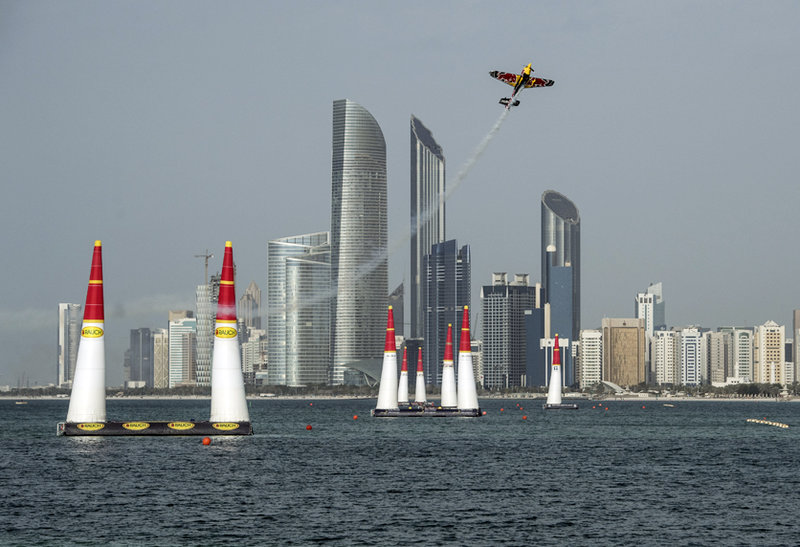
After eight years away, the Red Bull Air Race World Championship will return to fly over San Diego Bay April 15-16. Nicolas Ivanoff won the last race in the skies above San Diego and he’ll be back to defend this month. Ivanoff beat Paul Bonhomme by more than a second in 2009 and this year he will be fighting 13 other Master Class pilots to try and win. “I’ve got great memories of San Diego, and we have been good in America, so it should be a close race,” Ivanoff said.
The pilots of the Red Bull Air Race have been doing their homework on the San Diego track and the variables such as the weather. Race director Steve Jones, who raced in 2007 and 2008 and has a wealth of experience in what can happen in San Diego, said the race this year will be about weather conditions.
“The weather can be variable on the Pacific Coast,” said Jones. “There is the marine layer, which is a bank of fog that rolls in off the coast and can cover the track. In the past, it’s rolled close to the track but never covered it, so we’ll be hoping that’s as close as it gets.”
One advantage the race committee has is that it is able to get a lot of forecasts and information about the weather. This is thanks to the two major airports and the U.S. Naval Air Base that are in close proximity to the track. Also Jones’ fellow race director, Jim DiMatteo, lives in San Diego and knows the area well. “Due to the track’s location, wind will definitely feature in this race,” Jones said. “As we’re close to the ocean, it’s unlikely that it will be still. But if the wind is coming in from the coast it should still be smooth in the track. If the wind is coming off the shore, it will be turbulent because of the buildings, making it similar to Abu Dhabi.”
The track in San Diego is a 15 gate course over two laps. It has a tight 180-degree turn at one end and a vertical turning maneuver at the other. It looks to be a fast and simple track, but that’s what makes it exciting.
“Although it looks simple it means the pilots will have to fly it absolutely perfectly if they are to win. One small mistake will see them out of the running,” said Jones.
Once the pilots have flown through the Start Gate they have to navigate the chicane and then they head to the 180-degree turn, which has Gate 3 at the halfway point of the turn, so the pilots have to get their wings level before carrying on. “There’s a lot of time that can be won or lost in this turn, depending on the line the pilots take,” said Jones.
At the end of the turn is Gate 4 where they will have to level their wings again before heading to the single pylon at Gate 5. “This could cause problems. The pilots will want to fly super close to Gate 5 to set themselves up for Gate 6. If they fly too close, there’s a chance they’ll pick up a penalty,” Jones explained.
As the pilots go through Gate 6 they will have to line up their raceplane for the vertical turning maneuver at Gate 7. Due to the safety line, this is a judged gate, meaning the pilots have to have their raceplane vertical before they can make the turn towards Gate 8. If they don’t have the raceplane vertical before they turn they could pick up a one second penalty for “incorrect vertical turning maneuver.” After the vertical turning maneuver, it’s on to the Start/Finish Gate for the second lap. “The pilot who flies the vertical turning maneuver perfectly will have the best chance of winning. There are a lot of opportunities for penalties in the San Diego track, but it’s a great venue and we’re in for a really good race,” Jones said.
For more information and tickets, visit www.redbullairrace.com.


