


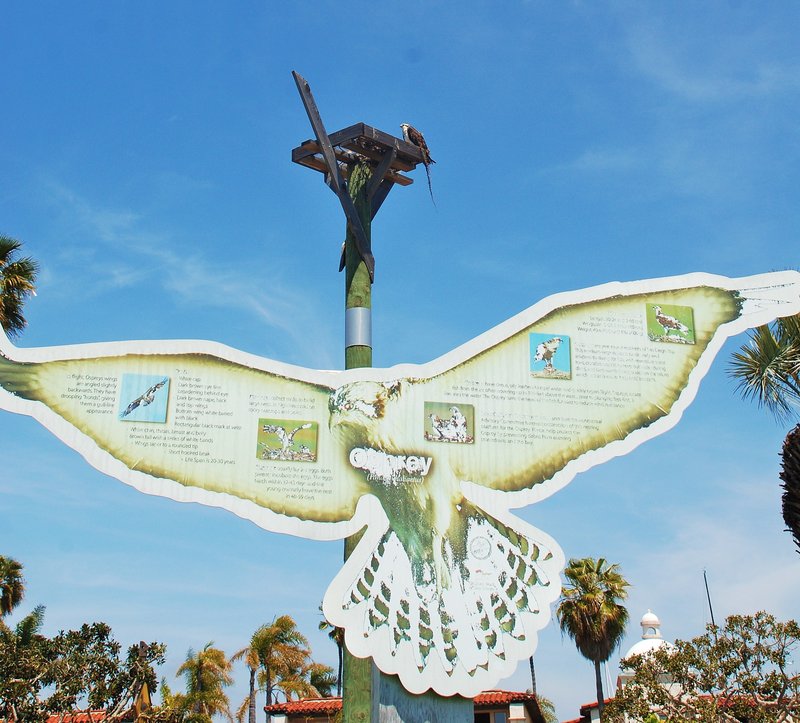
Ospreys are commonly seen soaring along California’s coastlines. From beneath, the large migratory raptor boasts an impressive wingspan extending more than five feet wide and rounded talons with a reversible outer toe that allows the seabird to grasp slippery prey. Ospreys can often be seen skimming San Diego’s waterways, hovering at heights up to 100 feet above the surface. Then, suddenly, in a swift motion, the osprey will plunge feet-first into the water, deftly taking hold of a fish several feet beneath the surface. Despite the abundance of the species today, the osprey population took a sharp dive in the 1950s and 1960s because of the excessive use of pesticides, which poisoned the birds and thinned their eggshells. In the 1970s, osprey populations began to rebound, in large part due to the 1972 U.S. DDT ban, according to the Cornell Lab of Ornithology, making the osprey a conservation success story. In San Diego’s tidelands, natural osprey nesting sites are few and far between because of shoreline development and a limited number of trees. To aid in the osprey’s continued recovery, the Unified Port of San Diego constructed five special nesting platforms around the San Diego Bay in April 2007, including one on Shelter Island near the Yokohama Friendship Bell. Recently, adult ospreys have been spotted atop the platform, making for quite a site for area visitors. Although the birds have never nested there before, expert Eileen Maher from the Port’s Environment and Land Use Planning Department said the ospreys may be pre-nesting for the fall. “The osprey could potentially build a nest in the fall,” she said. “Fledglings would then be flying by March or April 2013.” In addition to the platforms, information signs have been placed near each nesting site to educate passersby about the species, which is protected under the federal Migratory Bird Treaty Act of 1918. Over the last five years, 14 fledglings have been born from the platforms’ nesting sites, ensuring that San Diego is doing its part to protect the species that, like many others, can call this city home. For more information about the osprey nesting sites, visit www.portofsandiego.org/environment.


