


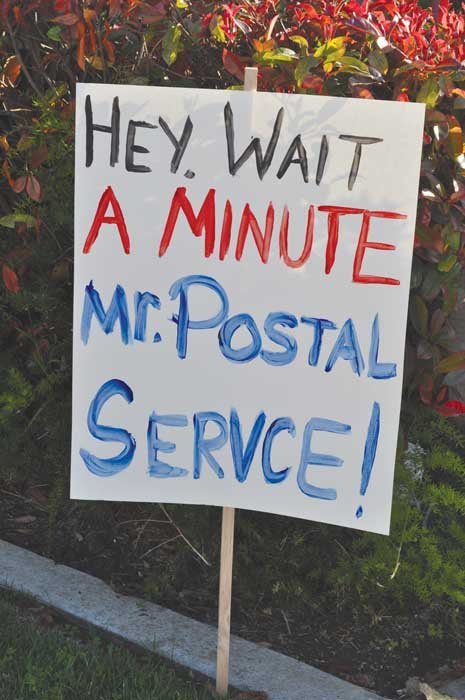
In the ongoing saga of La Jolla’s endangered post office, a new strategy for saving the Wall Street location has been formed by the Save the La Jolla Post Office Task Force. Going forward, said task force chairwoman Leslie Davis, the plan for keeping the building intact involves saving the post office “one day at a time.” The task force met at the La Jolla Historical Society on Aug. 3 to discuss the latest in the drama that has pitted the community and its beloved post office against a financially strapped United States Postal Service. The task force and community members working to keep the building and its services off the chopping block received a coup last week when Congresswoman Susan Davis (D-53rd) introduced the Community Post Office Relocation Act. The bill is designed to help save post offices that have been slated for relocation by the USPS by offering the communities in which they’re located the first opportunity to purchase them at fair market value. The community could then choose to lease part or all of the space back to the USPS. Congressmen Brian Bilbray (R-50th) and Bob Filner (D-51st) also signed the bill. One reason for the bill, said Leslie Davis, was to bridge the communication gap between the USPS and those fighting to save the La Jolla post office. The USPS, meanwhile, clearly got the message. Within 24 hours of the introduction of the bill to Congress, a representative of the USPS contacted Congresswoman Davis’ chief of staff in regards to the bill. “That is a positive sign of engagement on the part of the USPS,” said Leslie Davis. “It opens up those lines of communication, which are necessary to come to a beneficial outcome.” The fight, however, is far from over, she said. The three politicians (Davis, Bilbray and Filner) who have already declared their support for the bill may not be enough to push it through, and the key to its success may well lie with Congressman Darrell Issa (R-49th). Issa spearheaded the Postal Reform Act, which aims to restructure the USPS and bring it out of fiscal insolvency through various reforms — including allowing financially unsustainable post offices to be closed. Though it would seem on the surface like a hard sell — getting a politician who introduced legislation making it possible for the USPS to sell retail outlets on board with supporting legislation making it more difficult for the Postal Service to get the maximum potential profit from such sales — there is another factor at play. Issa, whose 49th District’s western edge previously extended only about as far south as Palomar Airport, will have a new community — and a new constituency — once the congressional redistricting takes effect in November. The district will include a small section of La Jolla, including La Jolla Farms. Task force members are hoping to get a face-to-face meeting with him this month, when he is rumored to be visiting La Jolla. “Issa,” said Leslie Davis, “is the key to our success.” Just in case a face-to-face doesn’t sway the congressman to their side, the task force has another plan in the works. Drawing on strength in numbers — and on the idea that a handwritten letter still has more influence than its typed or emailed counterparts — the task force will take part in the Aug. 17 “National Send a Handwritten Letter Day,” (started by a journalist and a librarian in New York and endorsed by the USPS) and is encouraging community members to write a letter to Issa in support of the Community Post Office Relocation Act. The group even drafted a sample letter from which letter writers can pull paragraphs or copy in full. The task force will man a booth at the Aug. 12 La Jolla Open Aire Market with information, envelopes, stamps and even the chance to sit down right there and pen a letter. They will meet at 9:30 a.m. on Aug. 17 to walk as a group — with community members invited to join — to the post office to mail the letters. Those trying to save the post office are hoping to show policy makers that the Wall Street building represents not only revenue — or lack thereof — for the Postal Service, but an iconic community hub that means more than money to the residents that gather there, said Davis. And if the future of the post office hinges on political might, residents can flex their power with their votes. “We’re hoping we can use the politicians to assist us from both sides of the aisle,” she said. “What it comes down to is there are a lot more voters than there are potential buyers [of the post office].”


