


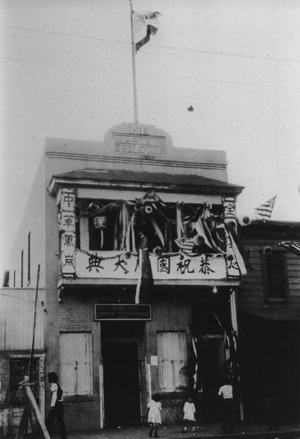
For more than 60 years, members of the Chinese community lived in a segregated part of San Diego, denied the privilege of becoming naturalized citizens and forced to work for low wages. The area was called Chinatown. The colony that housed more than 200 Chinese was bordered by Market Street, Fifth Avenue and the bayfront. Some were fishermen who drifted down from Monterey in search of albacore. The colony expanded to 500 in the 1920s and ‘30s with the influx of Japanese and Filipinos. Encouraged to chronicle the struggles of this Chinese population, Murray Lee, 84, published a book this year titled “In Search of Gold Mountain” — a historic look back at misguided Chinese dreams stemming from the lure of the California Gold Rush. Lee said there had been a famine in South China, coupled with the Opium War and other disturbances. “They believed California, a place they called Gold Mountain, would be their savior,” Lee said. “They sent the oldest member of the family to prospect for gold and send money home.” According to Lee’s research, the Chinese were not accepted by hostile pioneering gold minors, sparking extreme hostilities. As a result of the racial turmoil in California and the West as a whole, Congress passed the Chinese Exclusion Act of 1882. Between 1882 and 1924, other exclusion acts were enacted, effectively cutting off practically all entry of Chinese immigrants into the United States. As curator at San Diego’s Chinese Museum for 10 years, Lee collected photographs, illustrations and maps to tell the story of oppression and living confinement. The retired cartographer from Virginia took up residence 27 years ago with his wife near Soledad Road, which borders La Jolla and Pacific Beach. Shortly after arriving in San Diego, he joined the Chinese Historical Society of San Diego, where meetings were conducted in an old Chinese Community Church on 47th Street. The meetings broadened into the idea of establishing a museum that would unfold this history from the 1880s until World War II. Lee toured the county, visiting schools and clubs to tell the story. Through the Chinese Historical Society’s lobbying, an old Mission Building became a museum that was opened in 1996 on 3rd and J Streets. Lee credited the success to Mr. and Mrs. Tom Hom and Sally Wong. “The (society’s) goal was to eventually have a museum. The temporary tea room in the Horton Grand Hotel was not the answer,” said Lee, who still conducts walking tours through the eight blocks that once comprised Chinatown. “I was asked what I wanted to do there. ‘Be the curator of Chinese-American history,’ was my answer. I wanted to preserve this local history. Nobody was doing research so I began writing newsletters and a few articles.” The number of people living there varied, but seems to have always been in the range of a few hundred, according to records. Lee has examined Census figures that showed 202 Chinatown residents in 1880, including cooks, laborers, launderers, fishermen, housekeepers, merchants, clerks and physicians. In 1943, the Chinese were finally able to apply for citizenship and obtain meaningful jobs, including key work at Convair plane manufacturing. It was a far cry from work on the Flumbe and railroad, where pay was $1 a day. The book, published by Donning and Co from Chesapeake Beach, Va., has 352 pages and 245 photographs, maps and illustrations.


