


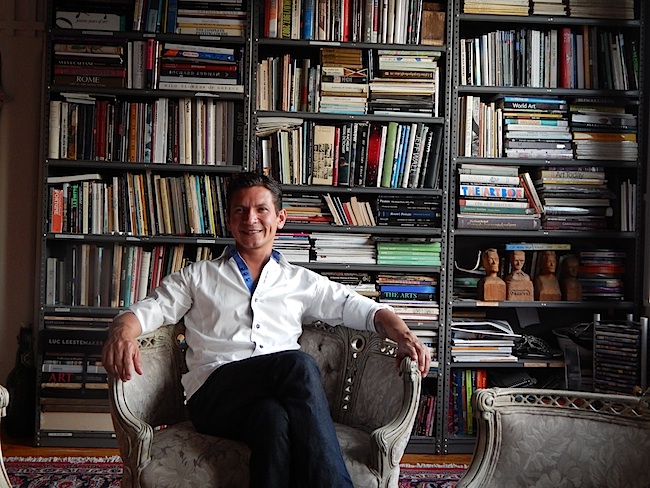
Downtown art dealer thrives through philanthropy
Morgan M. Hurley | Downtown Editor
When local art dealer Alexander Salazar finally opened up his own business in January 2010 after nearly two decades in the industry, choosing the right name was something he put a lot of thought into.
Motivated by an article that said those who go into business using their own name tend to be more committed and successful, Salazar found himself conflicted by the idea of using his given name, “Alejandro,” because it was hard to say.

“I wanted [my business name] to be something people would remember, not struggle with,” he explained.
Shortly after inking the deal using the American translation of “Alexander,” Lady Gaga released a song that would introduce “Alejandro” to the world, and although he admits to initially mourning a lost opportunity, he quickly took the news in stride, gleefully playing the song on repeat during the grand opening of Alexander Salazar Fine Art, located at the corner of Broadway and Seventh Avenue, Downtown.
Just under four years later, the openly gay art dealer is thriving.
“The one thing that runs a gallery business is art sales,” he said. “In the beginning, it was really awesome. People were really excited and very supportive. Then there was an in-between lull that got me a little worried, but then there was a big ‘wow.’”
His magic recipe seems to be his marketing endeavors – opening long-term mini-exhibitions at the Hilton Bayfront and Palomar, installing “pop-up” galleries in neighboring businesses, and hosting lots of charity events – which have all begun to pay off.
One of his most successful pop-ups has been a two-year exhibition at FIT Athletic Club on 10th Avenue. The FIT installation, like another at Downtown’s Zanzibar Café, are offered free of charge by Salazar, and offer those who wouldn’t normally have the opportunity to do so, a snapshot of the vast collection of artists he represents.
“People have said, ‘Why would you put art into a gym?’ but it is a [high end] gym and executives go there,” he said.

These exhibits resonate with art enthusiasts, especially when they become part of their daily routine. Salazar calls them “no pressure” exhibits, since sales only occur if someone sees something they like and then calls or visits his gallery, but it works.
Salazar was born the youngest of seven to Catholic, Mexican-American parents in Houston. He spent his undergraduate years at Colorado College before heading east to Boston College for a master’s in art history.
Not satisfied with just one master’s, he went on to attend Harvard University for theology and sociology, and later lived abroad in London and Italy before arriving in San Diego in 2001.
His unique educational journey not only helped shaped his taste and style, but also taught him important lessons for the career path he chose.
“[I learned] to be honest and have a conscience,” Salazar said. “The art world is very malnutritioned; it’s a hard business. A lot of people are jaded because they get ripped off. Some people do it for a few minutes and some do it for a lifetime. I plan to do this until I’m dead.”
His diverse and ever-expanding line of clients eventually caused him to separate his artists under differing brands. Aside from Alexander Salazar Fine Art, he also produces and curates under the names White Box Contemporary, Salazar – Contemporary Art Exhibits, and Salazar AIR.
Now in its third year, the AIR project occupies a small, 250-square-foot space just adjacent to Salazar’s main gallery on Broadway [see sidebar]. There, on a three-month rotational basis, he offers struggling artisans a studio of their own and lets them loose to create their art. It is an exercise in philanthropy for the 40-year-old art entrepreneur, since none of the artists pay him a dime to use the space.
“I’ve been an educator all my life, so I wanted to continue that by helping young artists. All I have to do is pay the bills and be patient,” he said, adding that those who create enough inventory are also promised a solo show in his gallery. The artists he selects for AIR are by invitation only and there is no application process, but there is one requirement.
“They have to be hungry,” he said.

White Box Contemporary, located at 1040 Seventh Ave., is an exhibit space Salazar describes as “smart” and “academic,” located just steps from his main gallery. From Aug. 10 – 30, Salazar will host “The Forest From the Trees,” there, an exhibit curated by Chris Trueman and Joshua Dildine showcasing the “intimate and extremely personal” work of four figurative painters from Los Angeles, Kimberly Brooks, Anne-Elizabeth Sobieski, Kathleen Melian and Erica Ryan Stallones.
Its 40-foot ceiling offers ample space on the walls to display as much art as he chooses, and his goal is to hang them floor to ceiling. Currently included are a pair of extremely large portrait photos of his adopted dogs – Lucky, a cocker spaniel-poodle mix and Mick, a schnauzer – that flank an equally large portrait of himself.
A half dozen other massive paintings and sketches of his own likeness are mixed with those of other people’s and adorn the expansive walls along with various other works, but it doesn’t even put a dent in his 1,000 piece personal collection.
“My passion is giant paintings – something about the enormity – I could fall into them,” he said. “I think I have a piece from every artist I’ve ever represented, too.”
From Aug. 10 – 30, Salazar will host “The Forest From the Trees,” at his White Box Contemporary gallery, at 1040 Seventh Ave. Curated by Chris Trueman and Joshua Dildine, the exhibit showcases the work of four figurative painters from Los Angeles, Kimberly Brooks, Anne-Elizabeth Sobieski, Kathleen Melian and Erica Ryan Stallones.
For more information about Alexander Salazar Fine Art visit his gallery at 640 Broadway, Downtown, or his website alexandersalazarfineart.com.


