


Danielle Durham rings a small silver bell and shouts over the crowded room of second- and third-graders, “OK, guys, it’s time to write your letter to the wizard!”
Several of the Torrey Pines Elementary School pupils line up at a table in the center of the small computer room, and others continue to mill around, all attempting to collect white-lined paper, markers and crayons.
Durham instructs them to write down questions about the educational games they’ve been playing during the day’s after-school session of the Fifth Dimension. The program partners University of California, San Diego (UCSD) undergraduate students with the elementary school, allowing them to act as mentors for the young children, guiding them through spelling and mathematical computer learning games and helping them with homework.
“It’s a little crazy in here today,” said Durham, a UCSD senior and psychology major, as one child pulled on her sleeve asking her to look at a drawing he made for his mother.
Durham, who has been a part of the program for more than a year, acts as a teacher’s assistant for the Fifth Dimension. The program’s quirky name originated from the story told to student participants about entering the “fifth spatial dimension,” where they can encounter wizards and other fun and unusual events. Students receive advice from the wizard each week, but his identity is always kept secret.
Durham explained that writing to the wizard is an activity that is intended to help the children expand their learning experience.
But the elementary children aren’t the only ones learning.
“As a psychology undergraduate, you don’t have a lot of opportunities before you graduate to have a hands-on experience working with kids in an academic setting,” Durham said.
For that very reason, she was prompted to get involved in the program and said she’d rather see how psychology is applied in everyday life instead of reading about it in textbooks.
Not only do the UCSD students get practical, hands-on learning experience from the program “” they also get course credit.
“It works at many different levels for the elementary students and the undergrads,” said Virginia Gordon, a former Torrey Pines parent and UCSD researcher. “The goal is to have this be a part of their education and help them learn about researching, taking ethnographic field notes, getting field experience and also how to live in the real world.”
The after-school aspect of the program, which meets every Wednesday for 10 weeks, was implemented for the first time this year, and has been successful, according to Gordon.
UCSD students arrive at noon, eat lunch with the elementary students, and then meet them in the computer lab after class for an hour of learning games that improve math, writing, science and geography skills.
After that, the UCSD and elementary students move to another room to work on homework, and another group of college, fourth- and fifth-grade students move into the computer lab for a later session.
For the last 10 years, the program has been a part of the school’s curriculum, with a scheduled time during school hours that enabled fifth-graders to research and create PowerPoint presentations with partners in the computer lab.
It has now expanded to include second- through fourth-graders and has continued to gain an even larger following throughout the county and even the world.
Mike Cole, who holds a special professorship within the University of California system, founded the program in 1981 as part of a case study for his research at UCSD.
“I was interested in why successful educational programs fail, and I wanted to study up close why people let good things die,” Cole said. “I’m also very interested in the problem of kids who really need extra help, and after school is a very good time to give this help and make learning interesting.”
Cole figured the program wouldn’t last. Instead, it was picked up by school systems as far away as Spain, Mexico and Brazil. And, for the last 10 years, it has become a key part of the Torrey Pines Elementary curriculum, with no sign of fading.
In fact, the program recently was one of seven partnerships in its school district to be honored with an Exemplary Award, according to Janet Delaney, the director of community relations for the San Diego Unified School District, which includes Torrey Pines Elementary.
“This particular partnership has withstood the test of time and retained all of its vitality and passion,” Delaney said, adding that the district has a total of 1,500 partnerships. “The district values that one-to-one relationship based on mentoring and tutoring, where you can spend time with just that one person. What I hope happens for these children is that they will see the UCSD students and think, ‘Maybe college is for me.'”
Delaney emphasized the importance of parents working closely with children and their teachers to make the partnership successful.
Felipe Barajas, a pupil in the group of second- and third-graders , is one of many who have gathered to play computer learning games as UCSD volunteers look on.
His mother, Maria Barajas, stands in the doorway and talks with Gordon in Spanish, while she watches her son work with UCSD senior and Fifth Dimension teaching assistant Tiffany Ford.
Several other mothers filter in and out of the room throughout the hourlong session, picking up their children or observing the day’s activities.
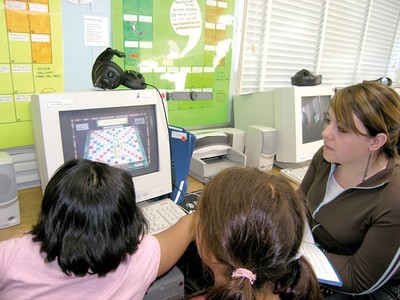
Across the room, Yvette Hermosillo, 9, and Clarissa Corrales, 9, are partnered with UCSD senior Jena Passaretti to work on a computer-generated spelling game, similar to Scrabble. Passaretti prompts the girls to look at the letters provided and try to form words.
Hermosillo and Corrales prop themselves forward in their chairs, point at the screen and engage in a candid argument about how to spell “tie dye.” Both girls, however, agree on one thing: Fifth Dimension is very cool.
“We get to hang out and work with cool people,” Corrales said, and Hermosillo piped in, “I love it.”
Cole, who was at that week’s session, sat in a small chair next to several students who were working at a computer station, quietly observing the learning process and interacting freely with the youngsters.
What he loves about the program is its positive impact on UCSD student volunteers, he said. If given the resources, Cole admitted, he would teach many more of the small classes, allowing UCSD students to participate in the Fifth Dimension..
“My hope is that people will come to appreciate that this is a really great way to improve undergraduate education and help the community at the same time,” he said. “This is a two-for-one, and it’s unusual when you find something that works like that.”
Although the professor visits many schools that use the Fifth Dimension, including Solana Beach in Orange County and several in Los Angeles, he said what makes the Torrey Pines program so special is the level at which parents and teachers are involved.
“It takes work at their end to maintain it ” you don’t just plant it and watch it grow,” he said. “It takes constant maintenance and these folks have done that and it’s great that it’s here. But it’s not everywhere.”
For more information, contact Virginia Gordon at [email protected] or visit www.uclinks.org/reference/inschoolmanual.pdf.


