


The term “hoop-and-pole” is innocent enough, at least as a descriptor for a children’s game. The contest involves a certain skill in archery, wherein the competitors shoot arrows at a circular object “” only this time, the object is rolling along hard ground, placing greater demands on the hand and eye.
Innocuous name, yes, but the game’s probably a lot harder than it looks.
For the Barona Band of Mission Indian children who played it prior to the 18th-century arrival of the Spanish to California, it was also an integral part of growing up. The era’s young sport archers were the hunters and gatherers of tomorrow, as depicted on Old Town State Park’s latest wall-to-ceiling mural. Officials from the Old Town Cultural/Historical Program, the Historic Old Town Community Foundation and the Barona band have ensured that that mural is installed where it will do the most good “” in a classroom designed to depict a journey through San Diego history.
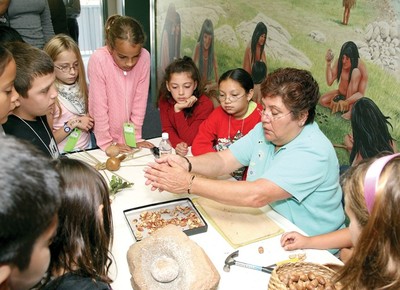
Called Native California, the space was unveiled Oct. 11 at the historical program site, 3939 Conde St. It’s the first of five such planned facilities, with the others to touch on topics such as the Native American’s role in America’s westward expansion. For now, about 60 fourth-grade students from the San Diego Unified School District contented themselves on dedication day with Native American games, lessons in grinding acorns for pudding (called shawii) and Barona-led talks about life in San Diego County five centuries ago.
The 12 Barona participants know something of what they declare. They’re the descendants of this region’s aboriginal group, which inhabited the area for 5,000 years and tracked nature and her seasons for their survival. The indigenous Barona have lived on the band’s reservation, near Lakeside in southeastern San Diego County, since 1932. And at either end of the time spectrum, said Barona Cultural Center and Museum director Cheryl Hinton, learning has been a primary tenet of the Barona way.
“When I interview tribal members for our Barona history project,” Hinton said, “I ask them what they wish for their children and all children. Invariably, everyone has said education is the key. That’s a very important theme for us.
“And just as the [district’s] kids go to school,” Hinton continued, “the mural shows the kind of classroom that children had 500 years ago. The mural is wonderful for that, because every little corner has a story in it. Whenever we have something beautiful and stimulating like this, it inspires imagination. It helps them be transported back in time.”
Those trips to the past are rife with negative connotations, Hinton said, adding that future lectures and depictions will pull no punches accordingly.
“To take the children back to some of those stories about the [mid-19th century’s] Gold Rush and the terrible devastation of the Indians “” that’s our challenge as educators. We have some stories that are hard like that. We have to convey them in the best and most age-appropriate way.”
The Old Town Program caters to more than 10,000 fourth-grade students from over 125 unified school district elementary schools. In accordance with state social studies standards, the program complements classroom instruction and introduces students firsthand to the cultural significance of local history and the people and buildings within it. The district’s board of education voted in April to invest in the program’s development through the construction of the new classrooms. Completion of the other four is expected in May.
Earlier this year, the Barona band and Wells Fargo & Company donated a combined $10,000 to develop Native California. Each got their money’s worth on opening day, when a dozen tribal members supplied the modern equivalent of the mural behind them. Hoop-and-pole may be just a game, they explained “” but in the scope of things, it’s a testament to antiquity and its vital educational component.
The Barona maintain an education grant program for schools throughout California. Further information is available at (619) 443-6612.


