


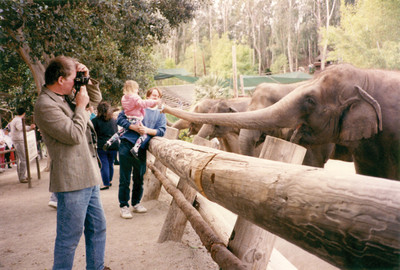
An unmarked grave covers multiple sins ” sins against nature. According to San Diego Zoo officials, useless elephants must be disposed of quickly and quietly. So Carol, the Asian elephant used by the zoo for more than 20 years as its ambassador and famous for her television appearances on “The Tonight Show,” Merv Griffin’s TV show and Glad bag commercials, was buried at the Wild Animal Park last week; not out of love, but because her lifeless 3-ton body was deemed too cumbersome to transport 30 miles to the zoo’s customary burial ground, the grisly “tissue digester.”
Carol was simply one more in a long line of elephants who have met an untimely death at the hands of the San Diego Zoological Society. In 2003, the Wild Animal Park discarded three aging African elephants in order to make room for young breeding-age elephants imported from the wild. Refusing to move the older elephants to a sanctuary, park officials instead sent them to Chicago’s Lincoln Park Zoo. As predicted by many elephant experts, all three were dead in less than two years, well in advance of their normal lifespan.
Fifteen Asian elephants have died at the Wild Animal Park since 1960. The average age at death was only 11.6 years, compared to 60 to 70 years, the normal lifespan of an elephant in the wild, when unmolested by man. Carol was 39.
There was no excuse for Carol’s premature death. Although Asians are forest animals who would normally spend their lives walking miles every day on soft forest terrain, she was chained by two legs on a concrete floor for more than half of her life, even after elephant managers were aware that such confinement and immobility greatly precipitate a variety of health problems, including chronic foot infection and degenerative arthritis. The San Diego Zoo had ample resources to create a more healthful environment for Carol but was in no hurry to do so. One can only conclude that they either did not know what they were doing, or did not care ” either of which demonstrates that the San Diego Zoo should not be keeping the world’s largest land mammal in captivity.
Four years ago, the international organization In Defense of Animals (IDA) began to expose the vicious cycle of foot and joint injury and disease in captive elephants with information obtained through state open-record laws.
“The pain and suffering that elephants endure is often hidden by the massive use of pain-killers and anti-inflammatory medicines,” states Dr. Elliot Katz of IDA. “The research of IDA staff has identified many elephants in critical need of urgent intervention.”
Since that time, nine U.S. zoos and several in the U.K. have either closed their elephant exhibits or announced plans to phase out their displays. Sadly, the San Diego Zoo is not among them. Instead of taking the lead in doing the right thing, the San Diego Zoo is bringing up the rear with plans for more elephants and a new elephant enclosure comprising a paltry four acres. In the wild, elephants walk 20 to 25 miles a day.
In perhaps the most arrogant and shameless display of misinformation yet, the Zoological Society has the audacity to be promoting television ads that portray animals in the wild begging to leave their forest homes in favor of life in captivity at the San Diego Zoo.
The zoo claims its captives are “ambassadors for the wild,” but now sends the message that the wild is undesirable and unworthy of protection.
We who care about elephants must join Dr. Katz, IDA and The Elephant Alliance in their commitment to end the zoo industry’s terrible and purposeful mistreatment of these gentle giants. Dr. Katz states, “It is time to re-evaluate the ethics and morality of keeping elephants in such unnatural and abusive situations.” The Elephant Alliance believes that the time has come to prohibit the keeping of elephants in captivity.
” Florence Lambert of La Jolla is the founder and director of The Elephant Alliance.


