


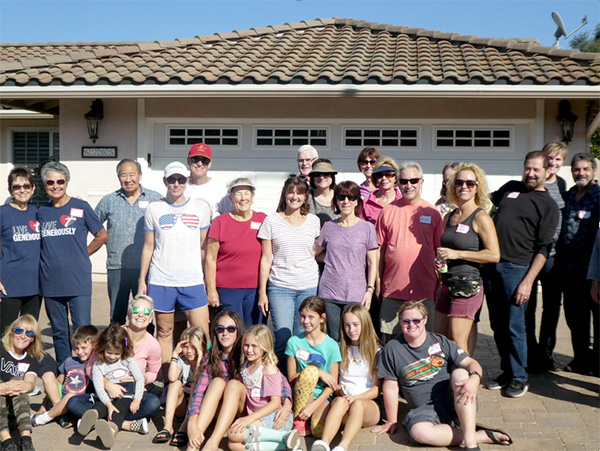
Thanksgiving food drive a huge success
The Salvation Army’s Thanksgiving Food Drive was a success this year, bringing in almost 4 tons of food — much of it from the Del Cerro community. The food drive is organized by Kassy, Lindy and Tom Kaiser, and other volunteers from Del Cerro.
The food collected was distributed to a new high of 105 families, who each received a box containing a turkey and all of the Thanksgiving dinner trimmings: dressing, Jell-O, pumpkin, cake mix, many cans of vegetables and fruits, dinner rolls, bags of potatoes, apples, and onions, dinner napkins and even a roasting pan and recipes for roasting a turkey, making dressing and gravy.

In addition to the Kaisers’ efforts organizing the food drive, other local people and businesses donated time and materials for the food boxes. Windmill Farms and Matt Mann provided the turkeys; Home Depot provided the boxes; Pat and Chuck McGregor provided the roasting pans; Nancy Losek collected food at Pizazz Hair and Nail Salon; and Jack and Candy Kirchner provided the use of their garage to put the boxes together. Each of these donors, along with over 50 volunteers and donors from around San Diego, participated in donating to the food drive.
The Salvation Army selected the recipient families and picked up the large boxes of food on Tuesday before Thanksgiving and delivered them to or had them picked up by the selected families.
The Salvation Army said that this is the only drive of its kind in San Diego where food is provided for the entire dinner — and beyond. The boxes contained enough food for the family for a week.
The Salvation Army honored the Kaiser Family with the Volunteer of the Year Award for their continued support in helping the Salvation Army provide food for less fortunate families for Thanksgiving.
“This is only possible because of the generosity and caring of the Del Cerro community and friends,” said Kassy Kaiser in a press statement.
Kiwanis planning ‘Sweethearts Ball’
To kick off the celebration of the first families moving into Allied Gardens 65 years ago in 1954, the Kiwanis Club of Grantville-Allied Gardens is planning an “I Love Allied Gardens Sweethearts Ball” on Friday, Feb. 8, 2019. The event will be a dress up, adults-only celebration of the 65th anniversary of Allied Gardens, held at the Allied Gardens Community Center from 7 to 10 p.m. Live entertainment will be provided by The Surf Birdz, playing songs from the ’60s and ’70s.
The gym in the Allied Gardens Rec Center will be decorated with a Valentine’s Day theme for the community event and gift baskets, donated by local merchants and friends, will be raffled off during the evening. The Kiwanis will also serve free anniversary cake to all the celebrants.
Allied Gardens was first conceived on June 12, 1952. Walter Bollenbacher and Louis Kelton purchased part of the 6,000-acre Waring Ranch on the north rim of a hillside rising eastward out of Mission Valley, on the outskirts of San Diego, to build the new housing development. The first subdivision map of Allied Gardens was recorded on May 25, 1953 and then grading for lot sites and streets started very soon afterward. Later in 1953, the first houses were constructed on Twain Avenue and then arrival of the first residents began in early 1954.
“Living in Allied Gardens, Del Cerro, San Carlos and the Navajo community is indeed the good life and we have much to be thankful for,” stated Kiwanis member John Peterson. “Let’s celebrate our good fortune with our friends, families, and neighbors at the Kiwanis I Love Allied Gardens Sweethearts Ball.”
Para más información visite alliedgardenskiwanis.org.
Credit card balances rise in San Diego
Before San Diegans head to the malls or online retail outlets this holiday season, a recent report on credit card balances may give them pause before swiping for that gift.
On Nov. 29, CompareCards released a report that found San Diego had the fourth biggest credit card balance increase in the U.S. in the past year. The average credit card balance in San Diego jumped 10 percent from September 2017 to September 2018, according to the report.
San Diego’s credit balance increase was much larger than the average of the nation’s 50 largest cities, which grew at 3.6 percent. Austin, Texas had the biggest credit card balance increase of 12 percent. St. Louis, San Jose, and Orlando also had double-digit balance growth increases. Only four cities saw balance decreases, led by Nashville.
Of the 50 top U.S. metropolitan areas, 44 saw some increase, though many were small. Washington D.C. had the highest average balances overall and Indianapolis had the lowest.
“It’s troubling to me that we’re seeing card balances continue to grow,” said Matt Schulz, chief industry analyst at CompareCards in a press release. “The truth is that if you’re carrying credit card debt when the economy is good, it likely means that you’re not putting enough money away for when things head south. Americans need to commit to making 2019 the year they finally tackle their credit card debt because rising interest rates mean it’s only going to get harder and more expensive to do so in the future.”
For the complete report, visit bit.ly/2QwkH8W.
Weber assumes leadership of Legislative Black Caucus
On Dec. 3, Assembly member Shirley N. Weber, Ph.D., assumed the chair of the California Legislative Black Caucus (CLBC). The CLBC, which addresses policy and budgetary issues affecting black Californians, consists of 10 African-American members of the legislature, including two Senators and eight Assembly members.
“I am extraordinarily grateful to my CLBC colleagues for their trust and support as we launch into a new and challenging legislative session,” Weber said in a press release. “Now more than ever, the CLBC has a vital role in ensuring that the needs of the African-American community are addressed by lawmakers. Aside from tackling the persistent challenges of poverty, educational inequity, over-incarceration and underemployment, we are faced with leadership in Washington that fosters a climate of hatred and violence against minorities, woman and immigrants. This caucus will join in solidarity with our colleagues in the Latino, API, LGBT and Women’s caucuses against this destructive trend.”
Weber, who was elected by her CLBC colleagues last fall, served as vice chair for the past two years and succeeds Assembly member Chris Holden of Pasadena in the role of caucus leader. She is joined on the CLBC leadership team by Senator Steven Bradford as vice chair, Assembly member Autumn Burke as secretary, and Assembly member Jim Cooper as treasurer.
The CLBC was successful on a number of its policy priorities during the 2017-2018 legislative session, including leave for parenting students, prohibiting unnecessary prosecution of children under 12 and securing $300 million to assist underachieving students.
In addition to coordinating legislative efforts affecting the African-American community, the CLBC makes recommendations to the governor on the annual budget proposal, sponsors forums and raises scholarship funds.
SDG&E files request to end high usage charge
On Dec. 4, San Diego Gas & Electric (SDG&E) filed a request with the California Public Utilities Commission (CPUC) to eliminate the state-mandated high usage charge, which impacted more than 105,000 customers this past summer. Eliminating the charge for high-energy users would minimize bill spikes during months when energy usage is high.
“It was a challenging summer for our customers, particularly for people who experienced dramatic increases in their bills due, in part, to the high usage charge,” said Scott Crider, SDG&E’s vice president of customer services, in a press statement. “We’re committed to doing everything we can to develop proposals that provide some relief to high bills, and we’re starting with requesting to eliminate this charge.”
The high usage charge led to higher bills for customers that used more than 400 percent of their baseline allowance. On average, these customers would have saved approximately $30 per month without the high usage charge.
The company is also exploring other proposals over the coming months. Ideas include eliminating seasonal pricing to stabilize bills, shifting the timing of the climate credit into a one-month lump sum in August to create meaningful savings in a month when bills are higher due to increased energy use, and conducting a new baseline allowance study to reflect changing climate and energy choices. Eliminating the high usage charge along with the other proposals would create real utility cost savings for families.
Pending approval by the CPUC, SDG&E hopes to eliminate the charge prior to the start of summer pricing, which begins June 1. Residents can also avoid the high usage charge by enrolling in one of several Time-of-Use (TOU) pricing plans, which are not subject to the charge. More information about TOU plans can be found at sdge.com/whenmatters.
Veterans to see boost in student services
Just before Veterans Day, the Grossmont-Cuyamaca Community College District announced news about expanded services and new facilities in store for its nearly 1,700 student veterans.
The two colleges have each secured $200,000 in state grants to expand outreach and services to veterans and their dependents. In addition, both colleges have plans in place to nearly triple the size of their Veterans Resource centers, with construction at Cuyamaca College set to begin next spring.
“The men and women in our armed forces have always been there to serve us, and we are proud and honored to in turn to provide them with the services they need to secure the education needed to reach their goals,” stated Grossmont-Cuyamaca Community College District Chancellor Cindy Miles in a press release. “Our district is deeply committed to helping them embark and stay on their journey to future success.”
California community colleges enroll approximately 80,000 veterans and active duty service members each year. More than 1,100 veterans are enrolled at Grossmont College and 562 enrolled last year at Cuyamaca College.
The Grossmont College grant will pay for a veteran program specialist tasked with providing operational support for the Veterans Resource Center and coordinating events and activities to help keep veterans on track and involved. In addition, Grossmont is in the planning stages of building a new, near-3,400-square-foot Veterans Resource Center with a large computer lab and quiet commons, a study center, a meeting room, counselors offices, a lounge and an outdoor patio, said Veterans Counselor Maria Martinez. The new center is scheduled to open in 2021.
At Cuyamaca College, the grant is paying for a part-time Veterans Resource Center coordinator, several new computers, a food pantry for veterans and their family, an expanded textbook library, and an “academic survival kit” complete with a flash drive, calculator, stationery, and pens, pencils and highlighters, said Veterans Counselor Osvaldo Torres.
In addition, Cuyamaca College is expanding its Veterans Resource Center from 870 to 2,487 square feet, with construction set to begin this spring. Veterans Services will be housed in a bungalow near the library while construction is under way.
Besides the Veterans Resource centers, those who have served have access to priority registration, tutoring, specialized counselors and more.


