


The San Diego Natural History Museum touts the same stateliness that marks many Balboa Park exteriors ” but on June 28, the venue served notice it’s what’s inside that counts.
When a crop of uniformed guards wasn’t checking photographers’ bags, it was turning away a befuddled public amid the museum’s closure for the day. The occasion was media only, and even that group underwent a solid credentials check and further scrutiny by a pushy lookout set to pounce at the hint of a false move. The Second Coming was imminent, with the museum’s security machine at full throttle accordingly.
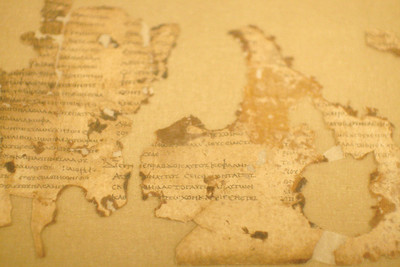
The Second Coming part wouldn’t quite pan out, but the event did involve a scriptural vestige that often taps its place in the public mind. “Dead Sea Scrolls,” the largest exhibition of Hebrew Bible artifacts ever assembled, was set to open at the museum the next day and is slated to run until the end of the year. About 400,000 patrons ” excluding the security detail ” are expected to view the exhibit, which includes landscape, aerial and wildlife photography, a film on the compilers’ ways of life and artifacts that reflect their civilization.
Museum enthusiasts also have a chance to attend as many as 22 lectures on the scrolls. Also being made available is a look at some exceedingly rare ninth- and 10th-century biblical manuscripts from the Russian National Library in St. Petersburg and handwritten bibles from London’s British Library that date to the 1400s and 1500s.
What viewers will miss, however, is a live statement by Risa Levitt Kohn, exhibit curator and San Diego State University Judaic studies director, who on June 28 declared that “Suddenly, what [I’ve] devoted my life to is cool again. I knew it was all along. But for historians, the scrolls are sort of a treasure trove of a period of time which we really knew very little about before this significant discovery.”
The scrolls, written chiefly in Hebrew and Jesus of Nazareth’s native Aramaic, date from 250 B.C. to about A.D. 65. They were found between 1946 and 1956 in the extreme northwest of today’s Israel in a series of 11 caves just outside Khirbet Qumran, a part of the Judean wilderness near the Dead Sea (this event features a re-creation of cave No. 4).
Twenty-seven of the Scrolls, 10 of which have never been exhibited, were transported from Jordan and Israel for the San Diego display. They’re part of a total of 900 extant manuscripts, only about 230 of which are biblical in nature.
The others reflect the commerce and laws of the Qumran region, whose maverick Essenes people were said to have broken from mainstream Judaic society to live communally.
From there, Qumran became a model of self-governance, with the scrolls reflecting the Essenes’ commitment to orderly lives and their resignation to the battle between good and evil. Angels and demons, war and peace, the municipal rule of law, the role of women in society, mystery and mysticism, the coming apocalypse: The topics address the best and worst of a civilization’s dreams, writ colossally larger than the scrolls themselves. Even the biggest among them is probably less than six inches across, appearing smaller yet under the extremely low light, designed to help slow the scrolls’ decomposition.
Their appearance, in fact, is about as unremarkable as the lunch over which museum officials decided to approach the Israel Antiquities Authority and the Dead Sea Scrolls Foundation about the prospect of an exhibit. A year later, their vision has taken shape, with museum president Michael Hager noting some incidental parallels between the locales involved. San Diego and Israel, he observed on June 28, are immigration centers and feature similar climates, plants and animals.
More important, he noted, they’re now major players in a monumental boon to San Diego’s cultural life. “It’s our job,” Hager said, “to bring the best of the best to San Diego. We take that responsibility very seriously.”
So does that antsy lookout, whose appreciation for the event was lost amid his express intent to purge the venue of the evil that surely stalked the halls on media day. But that’s another story.
The San Diego Natural History Museum is located at 1788 El Prado in Balboa Park and is open Mondays from 1 to 5 p.m., Tuesdays through Thursdays from 10 a.m. to 5 p.m., Fridays from 10 a.m. to 6 p.m., and Saturdays, Sundays and holidays from 9 a.m. to 7 p.m. Admission ranges from $15 to $28 for the general public, $10 to $20 for museum members and $15 to $20 for groups.
Tickets may be purchased at the museum, online at www.sdscrolls.org, or by calling (619) 255-0182.


