


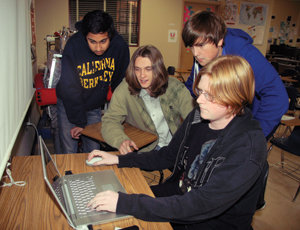
Five students from La Jolla High School braved the perils of cyberspace as they competed in the semifinals of the CyberPatriot challenge, a nationwide cyber security competition on Jan. 8. Patrick Sapin, Rafael Cosman, Jason Farnum, Andy Hill and George Brabon tested their cyber security skills against teams from across the nation, all vying for a chance to advance to the final round, to be held in Maryland in April. The LJHS team put up a good fight, but did not make it to the finals. Produced by Air Force Association, CyberPatriot aims to educate students in cyber defense, a concept LJHS senior Sapin, the team’s captain, said is crucial. “I think it’s really interesting. Cyber security and cyber warfare are very important topics in our society today,” he said. “There needs to be kids like us who are learning about it and this is a fun way to do it.” During the competition, teams of five students are given a compromised server, Sapin said. They must try to repair the server and “secure its vulnerabilities” within a certain time frame, and are given a score based on how quickly and efficiently they are able to do that. According to Sapin, the student competitors from LJHS are self-taught. Greg Volger, the high school’s computer science teacher and the team’s coach, approached a few of his advanced computer science students about the competition last year. They all expressed interest, and immediately began searching the Internet for tutorials on cyber security. Their efforts paid off, and they won the 2010 Mayor’s Cup Cyber Defense Competition in San Diego last March. “Kids nowadays spend time on the computer, and they read up on this kind of thing,” said Volger. “You hear about kids hacking into something all over the world. These are those type of kids, but they’re not interested in ruining something.” Now, competing against high school teams from across the country, the team has to step up its game. If they advance to the final round, the contestants will have to face not only the challenge of securing the compromised servers, they will have to do it alone. The number of computers the teams have to secure has risen with each round, and in the finals, contestants will have to compete solo, with each contestant working on one computer. The intent, as Volger points out, is to “understand security and what it means.” Such a premise, he said, ensures that younger generations will be prepared for a future in which cyberspace takes center stage. “CyberPatriot continues to encourage young people to explore the ever-evolving cyber realm, and the students are embracing the opportunity,” said Bernie Skoch, CyberPatriot commissioner, in a recent statement. Volger said the students could turn the experience into a job “right now.” ” They’re marketable,” he said. “This is a game for them, but it could become serious if they wanted it to.”


