


Parking currently confronts La Jolla as a major issue, but we can also reflect on times when it was a nonissue and the small population lived in a place that was without paved roads or vehicles, much less parking places. In an oral history in the La Jolla Historical Society files, early resident Sibley Sellew recalls how people walked from house to house for a game of cards at night carrying a “candle lantern: that’s just how we got around “” we went across lots and everything else.”
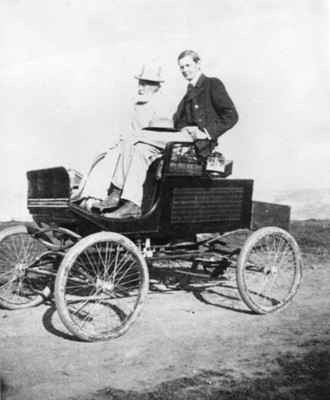
No cars were seen in La Jolla until the very early 20th century, and those that were definitely evoked curiosity. Ellen Mills who wrote considerably about early La Jolla life noted that a Mr. Herbert was the “proud possessor of the first queer little auto that La Jolla saw.”
“Mr. Herbert” was hardly just a Mr. Herbert. He was actually Lord Auberon Herbert, the son of the third Earl of Carnarvon, who visited La Jolla’s Green Dragon colony in 1902-03.
An incident has been recorded in the archives about Lord Herbert driving his automobile down Prospect in 1903: “The presence of an automobile was a cause of great excitement to La Jolla. One woman begged for a ride “¦ (she) began to squeal and shout. The steering of the automobile was controlled by a lever, not a wheel. The woman, in her excitement, leaned sharply against the lever; the machine ducked shortly to the left and fell over on its right side.
Nobody was hurt, but people stopped asking for rides, and the automobile enthusiasm dropped sharply.”
The second automobile purportedly was owned by Mr. and Mrs. Frank Booth, who called their contraption ” make unknown ” “the scissors grinder.”
The first aristocrat automobile to be driven in La Jolla was a Pierce Arrow owned by Ellen Browning Scripps, whose chauffeur never had a parking problem because he simply stationed it in the Carriage House on Eads Avenue which was part of the Scripps’ estate. (The Carriage House remains today and is used for storage by the historical society.)
As more automobiles came to be seen and driven in La Jolla, their dust on unpaved roads stirred a cause for paving streets, augmented by the problems they had after winter storms getting through the mud. Numerous historical accounts are given of vehicles slipping and sliding on the Biological Grade (now La Jolla Shores Drive) and in the Ravina Street canyon. The Biological Grade was made a concrete road in 1915, followed three years later by the paving of Prospect.
The automobile was changing La Jolla forever. Gasoline stations and car garages for repairs sprung up along the major thoroughfares. La Jollans began to talk about parking problems in the 1930s and ’40s. In 1946 it was officially addressed in the Eliot Plan proposing the first parking structures in the village.
The plan was never fully implemented, and La Jollans continue to talk about the parking problem in the village.
” “Reflections” is a monthly column written for the La Jolla Village News by the La Jolla Historical Society’s historian Carol Olten. The Society, dedicated to the preservation of La Jolla heritage, is located at 7846 Eads Ave. and is open from 10 a.m. to 4 p.m. Monday through Friday.


