


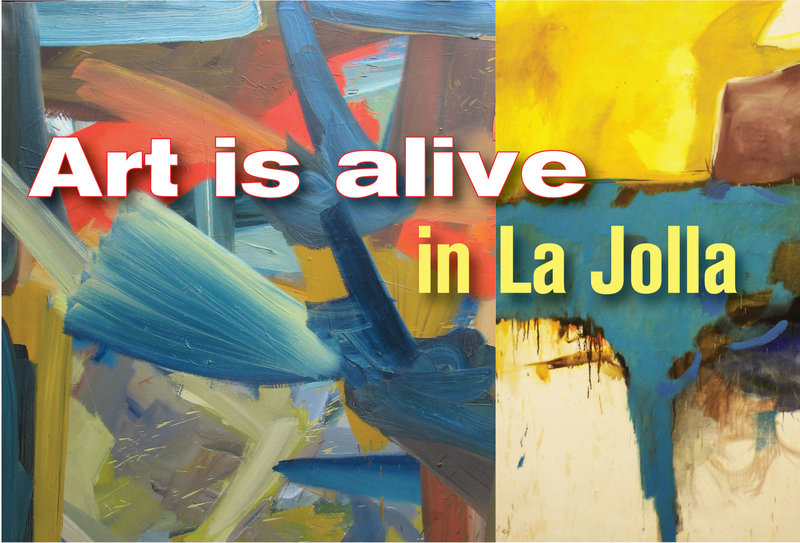
When Dave Hampton walks into the exhibit he curated for the Oceanside Museum of Art (OMA), he doesn’t see the works of art on the walls or the sculptures and pottery arranged around the room. He sees stories — narratives of artists’ lives and careers, from before their names were ever uttered in the art world to well after they became established in their field. “Some people see the art, the arrangement,” he said. “I look past the stuff and see all the stories, the people.” The exhibit, “Contemporary Art Wins a Beachhead: The La Jolla School of Arts 1960-1964,” details the lives of the artists who taught at the school before it became the Museum of Contemporary Art San Diego. The brief era was a magical period in time for art in La Jolla. As major contemporary art movements unfolded in art centers like New York City in the decades between 1940 and 1960, the attitude toward modern art started to shift. That adjustment, however, took about a decade to trickle down to places like San Diego, Hampton said. Just as it was beginning to take hold in the region, changes were happening at La Jolla’s Art Center, as well. Prior to the mid-1950s, the Art Center was a place where members would come and paint overlooking the coast; their work tended toward plein-air seascapes and portraits à la social realism. Then, in 1959, the director of the center was fired and Don Brewer, who had been working as the curator and assistant director, took over. The arrangement was unusual because Brewer was himself a painter, and it became more unusual still when he hired Don Dudley, also a working artist, as his assistant director. “My theory is that right when Brewer became the director, the staff became unusually dominated by actual practicing contemporary artists,” Hampton said. “That’s not to say the change wasn’t happening anyway, but that’s when it became crystallized. I mean, how many museums do you know about where the director is a painter, and the assistant director and staff are showing their art work in the museum?” That theory touches on the idea that when Brewer and his staff, who were all exploring contemporary movements like abstract expressionism, took over direction of the center and subsequently the school that formed there following an expansion of the space, they were free, for the most part, to push it in whichever direction they chose — and they chose to follow the trend away from the conservative styles of the past. Change is never universally accepted, and the emerging contemporary artists found that their situation was no different. Roughly a decade earlier, local artist John McLaughlin had won a prize in the San Diego Art Guild exhibition for an abstract painting, making headlines in the San Diego Union for two days straight and dominating the opinion page with angry letters. “You can extrapolate from that that there was a lot of reaction like that [to the contemporary art movements],” Hampton said. “There was also the idea that if you showed too much of this, you might alienate the people who could support you — the major donors who might have traditional art values.” Whatever the public reaction, however, the artists and teachers at the La Jolla School of Arts were somehow able to create their own little world in which modern art could flourish. Artists like Fred Holle, Sheldon Kirby, Malcolm McClain, Rhoda Lopez and Guy Williams were given the freedom to create whatever their minds could produce, while having the unusual luxury of holding full-time jobs as teachers at the school. The school, meanwhile, was careful not to isolate those who had been coming there long before it secured its place in the contemporary art world, from the casual Sunday painters to the serious students pursuing a career. OMA’s exhibit follows those artists — Holle, Kirby, McClain, Lopez, Williams and Dudley — from before their time at the La Jolla School of Arts to after what Hampton describes as a “mini exodus of really talented artists” from San Diego. After a few years, the school was unable to sustain itself. The board of directors realized it could partner with UC San Diego, and by using university faculty to teach classes, it wouldn’t have to pay its own teachers. “That’s another reason this period is such an interesting little era,” Hampton said. “It brought all these people together, and they were all acknowledged by an important art community. It put them together for several years, then suddenly put them all asunder. When the job dried up, almost all of them had to go elsewhere to look for work. Some went to San Francisco, some to LA and New York. Only two remained in San Diego. It’s hard to say if they all could have stayed or if something left them with a bitter taste. They were all upset when the school closed, and the sentiment was that they were not given enough time to adjust. The bottom line is that everybody left, and you get this abrupt end, this full stop of this whole scene.” While the era ended for the Art Center and its school, however, San Diego’s art scene was forever changed. By 1964, Hampton said, pop art had come along, “blowing abstract expressionism out of the water.” Radical changes were happening, and there was no stopping them. It is this uncontainable movement, along with a quote from local art and architecture writer Jim Britton, that inspired the title for OMA’s exhibit. “There used to be such a cry against modern art, such a negative reaction to it,” Hampton said. “Jim Britton wrote in an article that those stream of complaints had reduced down to a trickle, and that it seemed modern art had won its beachhead. I thought it was such a neat idea, that modern art was an invading force, and where it had landed and held ground was on the beach at the La Jolla Art Center. It’s a compelling idea.” “Contemporary Art Wins a Beachhead: The La Jolla School of Arts 1960-1964” will be on display at the Oceanside Museum of Art, 704 Pier View Way, through July 8. For more information, visit www.omaonline.org or call (760) 435-3720.


