


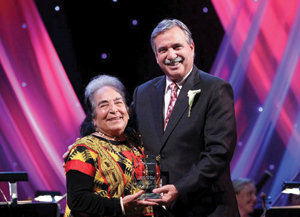
For La Jolla resident Gracia Molina de Pick, serving those who suffer from discrimination and poverty is a family duty. Her mother had eight sisters who were all involved in the women’s suffrage movement in Mexico and her greatest mentor, Aunt Elena, was a close friend of internationally heralded artist, pacifist and feminist Frida Kahlo. All these influential loved ones passed the torch to Pick, 80, who was recently honored as a local hero for her 60-year commitment as an educator, feminist, student mentor and community activist. In conjunction with Hispanic and American Indian Heritage month celebrations, KPBS and Union Bank presented her with the award Nov. 16 at the Museum of Contemporary Art in La Jolla. Her activism for women’s equality, indigenous communities, and labor and immigrants’ rights has culminated in progressive and concrete milestones. Molina de Pick founded IMPACT, a community grassroots organization fighting for Mexican-American civil rights, and Comision Femenil Mexicana Nacional, the first national feminist Chicana Association. She has also been a chairwoman of both the National Women’s Political Caucus, a grassroots organization dedicated to increasing women’s participation in politics, and the National Council of La Raza, the largest national Latino civil rights organization in America. She organized Chicana participation in the U.N. World Conferences on Women, and she has also published a book that highlights women in the indigenous period in Mexican history. The book is titled “Mujeres en la Historia y Historias de Mujeres.” “There are only two ways to change things in society — one is by the vote; one is by the gun,” Molina de Pick said. Her passion for peace, equality and justice runs deep in her veins, and her activism began at a young age. In high school, Molina de Pick was involved in post-World War II peace movements and political efforts to get women the right to vote in national Mexican elections. By 16, she founded and led the youth section of the Partido Popular, the only political party at the time that advocated women’s voting rights. After moving to San Diego with her husband, Richard, in 1957, Molina de Pick continued to emphasize the importance of voting rights and education in creating peace. Within a few years in San Diego, Molina de Pick saw the oppression of the Hispanic population in schools where she worked, such as National City Junior High, where 70 percent of her students were Hispanic and undereducated. Many of her Hispanic students were even placed in mentally disabled classes because they did not speak English. From that point on, Molina de Pick became instrumental in educational reform in San Diego. She founded and wrote the curricula for the first associate’s degree in Chicano/a Studies at Mesa College — the first degree of its kind in the country at a community college. In 1970, she became a founding faculty member of the University of California, San Diego’s Thurgood Marshall College. “There has been a tremendous amount of change, but communities are still segregated,” she said. She continues to push for educational programs, such as MANA, formerly the Comision Femenil Mexicana Nacional, which she helped establish. Among the many generous contributions that she has made to educational reform in the San Diego community, the most incredible is saving the Logan Heights Library by draining her own bank account. “I gave the last of my money that I had in liquid, $80,000, to the Logan Heights Library,” she said. “I believe in libraries, I live in the library and I wanted a library in the barrio.” To contribute further, the La Jollan held her 80th birthday in the library and asked for donations to the fund in lieu of personal gifts. Additions to the library’s endowment fund totaled more than $6,000 that day. Her spirit, generosity and passion has been such an inspiration that Jan. 12, 2010 was designated Gracia Molina de Pick Day in San Diego. Molina de Pick said she intends to move back to Tequisquipan, Mexico, where she has a small home, and continue her activist efforts there. Her next project is to begin a scholarship fund to help students buy textbooks for school.


