


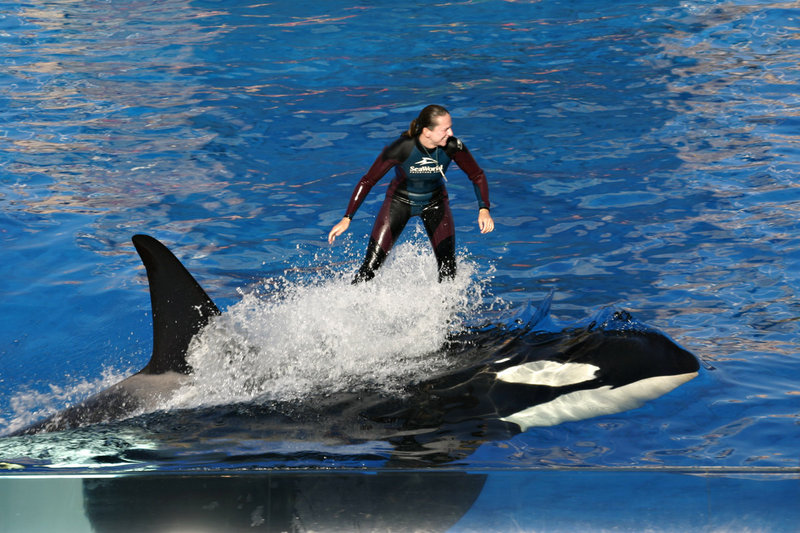
The killer-whale show will go on at SeaWorld San Diego, but there won’t be any trainers diving off Shamu’s nose. A judge ruled on May 30 that the popular theme park will have to find a way to protect trainers during performances involving the killer whales. The decision by administrative law Judge Ken S. Welsch is the result of the 2010 death of SeaWorld trainer Dawn Brancheau, who died while interacting with Tilikum, a 12,000-pound orca, at the Orlando, Fla., theme park. The ruling partly supported citations by the Occupational Safety and Health Administration (OSHA), which cited SeaWorld for “willful” safety violations. However, the judge reduced proposed penalties of $75,000 to $12,000, and changed a “willful” citation to “serious.” A willful violation indicates an employer acted with intentional disregard or indifference, which the judge said was not the case. OSHA also withdrew one of its three citations. SeaWorld was fined $5,000 for failing to equip two stairways with standard stair railings on each side of the stairways and $7,000 for exposing animal trainers to hazards when working with killer whales during performances. The third citation, which OSHA withdrew, alleged SeaWorld failed to enclose outdoor electrical receptacles. At SeaWorld San Diego, killer whales perform in three shows: “One Ocean,” “Shamu Rocks” and seasonally, “The Shamu Story.” During the summer months, “One Ocean” is performed up to four times a day and “Shamu Rocks” up to twice a day. San Diego is home to the first SeaWorld, which opened in 1964. During the 1980s and 1990s, trainers swam in tanks with the killer whales and performed by diving mid-air from the noses of the orcas. In 2006, SeaWorld suspended “waterwork” with killer whales Kasatka and Orkid as a result of their aggressive behavior toward trainers. “Waterwork” is any interaction a trainer has with a killer whale where water hits higher than knee-deep, according to Kelly Flaherty Clark, a curator of animal training at SeaWorld Orlando. The other type of interaction between trainers and killer whales is known as the “drywork” interaction, where the water is less than knee-deep to the trainer. Up until the judge’s ruling, trainers at SeaWorld San Diego interacted with whales out of the water, giving commands and food from a stage above the tank and standing on the side of the pool. Trainers also were able to pet killer whales in several inches of water on a slide-out platform. Brancheau died when she was engaged with Tilikum while lying down on the slide out, according to court documents.


