


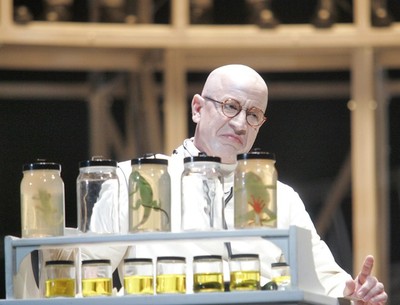
Saturday night at the Civic Theatre, San Diego Opera came of age with a sizzling new production (the company’s first) of Alban Berg’s 1925 German Expressionist opera, “Wozzeck.” The text of the tragedy, based upon Georg Bãchner’s drama, was sung in English and simultaneously projected over the proscenium.
Not only did San Diego Opera chalk up an “A” for sophistication and daring; the production provided La Jolla Playhouse artistic director emeritus Des McAnuff, whose staging was his first foray into grand opera, to depart the city with laurels of a new kind. Let it be said that he more than fulfilled one’s expectations as to what a McAnuff-staged opera would be.
The opera is a masterpiece of text, music and orchestration; the pairing of McAnuff and “Wozzeck” by San Diego Opera artistic/general director Ian Campbell is also a stroke of genius; and the San Diego Symphony played magnificently under the baton of resident conductor Karen Keltner.
McAnuff assembled a crackerjack design team comprising people with whom he’s worked here and in New York: scenic designer Robert Brill (“The Wiz”); Tony Award-winning costume designer Catherine Zuber (“Dracula”); lighting designer Howell Binkley (Tony Award for “Jersey Boys”); choreographer Kelly Devine (“Private Fittings”); and fight director Steve Rankin (“Jersey Boys”). UCSD-TV and Kreklow Film and Television produced the stunning video footage, and scenery automation (yep) was designed by San Diego State University/STAR Laboratory.
Brill’s revolving metal set represents a medical operating theatre, the neighborhood streets and tenement and, possibly, even a bullring. San Diego Opera chorus and supernumeraries contributed much.
German bass Franz Hawlata heads the company as Wozzeck, a simple man who unravels before our eyes. He is tormented by medical experimentation (he willingly submits because he needs the extra money), psychological abuse from his captain (American tenor Chris Merritt, extraordinary in the high-ranging part), and disdain from others in his regiment due to the infidelity of his mistress, Marie, mother of his son.
Hawlata’s magnificent voice is beautifully colored, and he is a fine actor. American dramatic soprano Nina Warren, also a fine actor, sings the voluptuous Marie, involved with Wozzeck for five years. She simply can’t resist the Drum Major (American tenor Jay Hunter Morris). American bass Dean Peterson sings the role of the creepy doctor, harbinger of later human medical experimentation. Others in the impressive company of operatic actors are tenor Joseph Frank as an Idiot; baritone Daniel Hoy as Second Journeyman; Israeli mezzo soprano Susana Poretsky as Marie’s friend, Margret; bass-baritone Scott Sikon as First Journeyman; and tenor Joel Sorenson as Wozzeck’s concerned friend, Andres.
It’s a tawdry tale: just think infidelity and murder as in Georges Bizet’s “Carmen” or Tobias Picker’s “Therese Raquin.”
Berg’s frequently atonal music ” by turns playful, lush and rife with difficult harmonies and intervals ” is suited to the 20th-century tragedy (the drama premiered in 1914). One of the score’s most charming moments is an off-kilter waltz, played when Wozzeck discovers Marie and the Drum Major dancing lasciviously in the local tavern.
The production’s most stunning visual effect is Wozzeck’s accidental drowning (or was it suicide?). Aided by watery projections, Brill’s suspended light grid, effective in numerous ways previously, becomes integral to showing Wozzeck’s death.
At the end of 90 musically and dramatically riveting minutes, the applause was sustained. There were many shouts of approbation, though one would wish for appropriate use of “bravi,” or “bravo” or “brava.” To the audience’s credit, however, there was not an immediate exodus, nor did I see anyone depart in the middle of the opera. As San Diego Opera comes of age, San Diegans are more game, apparently, than we knew. Perhaps in the future we needn’t travel north and beyond to see and hear something beyond the usual Puccini, Verdi and Mozart.
Two performances of “Wozzeck” remain, at 8 p.m. Friday, April 20 and 2 p.m. Sunday, April 22. For tickets and information, visit www.sdopera.com or call (619) 533-7000.


