


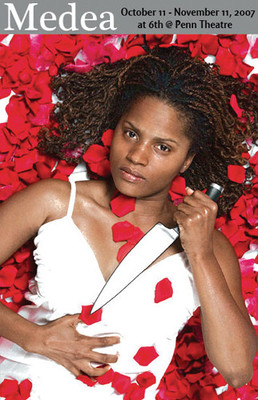
Sixth@Penn opened a haunting new production of Euripides’ “Medea” (translated by University of California, San Diego professor Marianne McDonald) Thursday, Oct. 11.
Director Ruff Yeager stages the work as ritual upon a stark white set of his own design. Yeager is responsible for the impressive sound design, engineered by Jean-Pierre Prieur. All the characters are clad in Jamie Lloyd’s effective white and off-white costumes.
Medea (Monique Gaffney) and the Nurse (cello-voiced Darlene Cleary) are on stage when the lights come up. Allison Finn, who simply appears, comments on what transpires and represents the people of Corinth as the Chorus. The Nurse begins the story, relating a simplified version of how her mistress came to Corinth, where she bore two sons to Jason (“an evil man who speaks well”), and then was dumped in favor of the king’s daughter. In effect Jason says, “We can live better, don’t you know?”
There are five backlit doors through which other characters enter to advance the story, translated into modern American vernacular. This “Medea,” however, has no time or place.
The stage is set with a low white table behind which Medea sits upon a bearskin rug, silhouetted against a large opaque window (lighting by Mitchell Simkovsky). On three lower tables downstage are crystal vases. Medea fills two with water ” one to hold the denuded and brittle rose stems brought to her by King Creon (Steven Jensen), who grants her one more day in Corinth, and another to hold the long-stemmed red roses given her by Aegeus (John Martin), who promises her safe haven in exile. She pours what appears to be white sand into the third vase. These elements are used as Medea prepares the poison to kill Creon and Jason’s bride and, later, as she steels herself to slay her own children and go into exile.
Gaffney employs her dance experience in movement and ritualistic movements, sometimes mirrored by the Chorus. Cleary and Finn are understated, dignified and never preachy in speaking McDonald’s translation, which is entirely feminist and frequently amusing in its description of the philandering husband for whom one feels little sympathy. The opportunistic Jason is played by handsome, well-spoken John DeCarlo. Clad in a marvelous white kimono, Joseph Deonisio portrays the Tutor of Medea’s unseen children.
Medea’s early utterances are intentionally distorted (just like a 911 call) and projected on the set’s white walls (just like on TV), which at times bear images of children. Diverse in age and skin color, they represent every child ever slain by mothers pushed to the limit by unfeeling, preoccupied men. Gaffney’s Medea is far from insane, knowing that when she stabs her sons she will stab Jason in the most unbearable way.
Yeager’s staging may not be everyone’s cup of tea. It is refreshing as a palate cleanser and jaw-dropping beautiful as an October sunset. The drama and tragedy are in the words. The style distances onlookers from the tragedy some may prefer to see acted out more realistically. Here the characters seldom make eye contact, and even argumentative dialogue overlaps just as in real life, as if the arguers hear only themselves. Any way it is told, the story is heartbreaking.
Not to be missed by classics buffs and those wanting to taste something different, “Medea” continues at 8 p.m. Thursday through Saturday and 2 p.m. Sunday through Nov. 11. Sixth@Penn is found at Sixth at Pennsylvania in Hillcrest. For tickets ($18-$23) visit www.sixthatpenn.com or call (619) 688-9210.


