


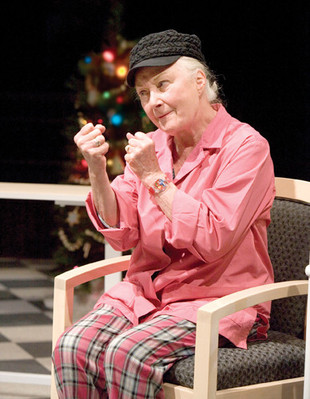
Classical actor Rosemary Harris has so many ties to San Diego’s Old Globe Theatre that they alone might account for her current Cassius Carter Centre Stage appearance in Eric-Emmanuel Schmitt’s “Oscar and the Pink Lady.”
One needn’t be a rocket scientist to reckon why the Globe invited Harris to the Globe and quite likely asked her what she’d like to do as well. Her first husband was actor/director Ellis Rabb (1930-1998), founder of the Association of Producing Artists Repertory Theatre (later the Phoenix), of which she was a member. Rabb and APA were an early influence on the young Jack O’Brien, who met Rabb when the repertory company took up residence at University of Michigan. Rabb introduced O’Brien to the Old Globe Theatre. Jennifer Ehle, Harris’s daughter (by second husband, novelist John Ehle), received a Tony Award for her appearance in the O’Brien-staged “The Coast of Utopia” at Lincoln Center last season.
“Oscar and the Pink Lady,” to which Harris was introduced by director Frank Dunlop, is a one-woman script adapted from a French novella. A 90-minute script is not an easy challenge, especially for an 80-year-old actor (the Union-Tribune says 77), but Harris is up to the challenge. A prompter sits in the front row, largely unneeded, and called out at least once, but so discreetly my companion missed it.
Set in the ward of a children’s hospital just before Christmas, the script allows Harris the opportunity to play many characters; mostly Oscar, a dying 10-year-old and the pink lady he calls “Granny Pink,” who attends his emotional and spiritual needs by suggesting that he write daily epistles to God. In each of 12 letters (the number of days she’s been granted permission to visit “” usually she comes only twice a week), Oscar may ask for one intangible thing.
Thus, Harris plays other children introduced in Oscar’s letters as well as her own youthful self, about whom she fabricates stories of a life in wrestling. She comforts Oscar by telling him he will live an entire lifetime in 12 days, aging a decade with each letter. His progression through the teen years is remarkably funny, though entirely whimsical. Harris’ slight swagger when she is in Oscar’s persona is truly delightful.
One must suspend disbelief throughout the evening, and sadly the piece goes on too long. Perhaps the script itself does not exceed 90 minutes, but with an interval it drones on for two hours, marked by the letters, the passage of time, and the decade-by-decade aging. It’s like putting a moving clock on the stage: You think midnight will never come. To put it mildly, one can’t wait for the kid to die.
There were many weepers when the end did come, but by then I was so exasperated with the episodic nature and general stasis of the work that I ” normally a sucker for death ” was merely waiting for the lights to come up.
It is sad that Harris, who copped the 1966 Tony for Eleanor of Aquitaine in “The Lion in Winter” and who has had a long, distinguished career in theater, television and film, doesn’t have a better vehicle for her considerable talent than this. That having been said, those who venerate the surviving eminence grises of the American classical theater and those inspired by an evening of fine technique should rush to Balboa Park for this unusual opportunity.
“Oscar and the Pink Lady” continues Tuesday to Sunday through Nov. 4 in the Cassius Carter Centre Stage, Old Globe Theatre. For tickets and information, visit www.theold
globe.org or call (619) 23-GLOBE.


