


How much money would it take to change a life?
Winning the lottery sounds like the big payoff for most people. A promotion at the office would probably make a difference. Even a holiday bonus would help.
For the world’s poorest citizens, surviving on the equivalent of less than one U.S. dollar per day, a microcredit loan of $25 can change lives dramatically, according to Bruce Underhill, a Pacific Beach resident and national board member of RESULTS. This nonprofit, grassroots advocacy organization writes letters to editors to increase awareness and lobbies elected officials to support policies to eliminate hunger and the worst aspects of poverty.
“People feel like they can’t change City Hall, but interacting with politicians on a regular basis does make a difference,” Underhill said. “If we do our civic responsibility, then the politicians are very interested in what their constituents think as a whole.”
One of the programs that RESULTS volunteers write about and lobby for is microcredit, small loans of typically $25 or $50 that enable the very poor, usually women, to start their own small businesses. Microcredit has gained more attention since Dr. Muhammad Yunus and the bank he founded, Grameen Bank of Bangladesh, won the Nobel Peace Prize last October for inspiring the microcredit movement. Yunus is also a board member of RESULTS and the RESULTS Educational Fund.
“He’s a calm, warm, incredible guy,” Underhill said about Yunus, whom he met in Bangladesh in 1995 on a RESULTS trip.
Working on the local level, Underhill has been providing leadership since 1984, when he and five other volunteers formed a San Diego RESULTS group. He made his own headlines that first year, writing his first letter to the editor of the San Diego Union-Tribune that was published with the title “Hunger Can Be Ended.” He’s been involved ever since, while teaching math at San Diego Mesa College and Southwestern College.
As an engineer with an MBA in management science, Underhill wanted to apply the problem-solving approach he developed in his professional life to help solve world issues, starting with hunger. He said it made sense that if families were making some money, they could buy food for their families.
“It’s the ultimate form of a hand up instead of a handout,” Underhill said.
Microcredit makes small loans to women living below the poverty level. The women typically work together in a group of five, and they are responsible for each other’s loans as well as the success of every member of the group. They may buy a cow to sell its milk or a chicken to sell its eggs, starting a home-based business that provides for themselves and their families. Once they repay the loan, they are eligible for a larger one to expand their business.
“They work together for mutual survival,” Underhill said.
Documented results are one of the most satisfying aspects of RESULTS, according to Underhill. In 1997, RESULTS held the Global Microcredit Summit in Washington, D.C. The group’s goal was to reach 100 million of the world’s poorest families by the end of 2005.
“At first, people were blown away by that goal,” Underhill said. “But we approached them with what role did they want to play to make that goal happen?”
By the end of 2005, microcredit had reached more than 113 million clients, 82 million of whom are among the poorest, according to Dalia Palchik, assistant media director with the Microcredit Summit Campaign. She said the organization expects to help from 82 million to 100 million of the poorest by the end of this year or early 2007.
“In development, it’s unprecedented to reach such a goal,” she said.
Deborah Lindholm, a La Jolla resident, has also been focused on that goal. She has worked with Underhill in her role as executive director of Foundation for Women, an organization she founded in 1997 as a grassroots microcredit movement serving impoverished women worldwide.
“God had a really good idea 10 years ago, and I was in the right place,” she said.
With a background in education and psychology, Lindholm had traveled the world as co-founder of a financial research company. She saw a great deal of poverty ” and then saw microcredit as a solution.
“Microcredit is the exact opposite of what a regular bank would do, where people with money are expected to come in. We work with people without money, and go out to them,” said Lindholm, adding that the repayment rate on the loans is better than 95 percent.
One of her favorite examples of how microcredit works involves a woman in Nepal who lived on the side of the road with her husband and two children. She had never seen the equivalent of $4 U.S. before, but once she received the loan, she bought a comb, scissors and mirror, and put her husband in business as a barber to feed their family.
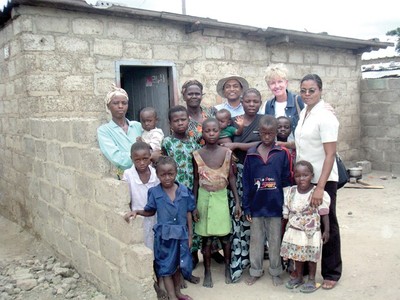
Foundation for Women currently operates microcredit programs in Tamil Nadu, India and Zambia, Niger and Liberia. The foundation also has similar programs with larger loans of $200-$1,000 for impoverished women in San Diego.
“The beauty of microcredit is bringing women together,” Lindholm said. “It’s so powerful to see what happens.”
Lindholm and other members of her foundation attended the second Global Microcredit Summit in Halifax, Nova Scotia late last year. The summit set a new goal to reach 175 million people with microcredit by 2015, and to help 100 million of the world’s poorest families move above the U.S. $1 a day threshold.
One of Foundation for Women’s efforts toward that goal is a campaign for 10,000 people to donate $1 a day for 100 days.
“We want to get a lot of people to do a little instead of a few people to do a lot,” Lindholm said. “It says, ‘I believe in you.'”
For more information on RESULTS, go to www.results.org. For Foundation for Women, call (858) 483-0400 or visit www.foundationforwomen.org.


