


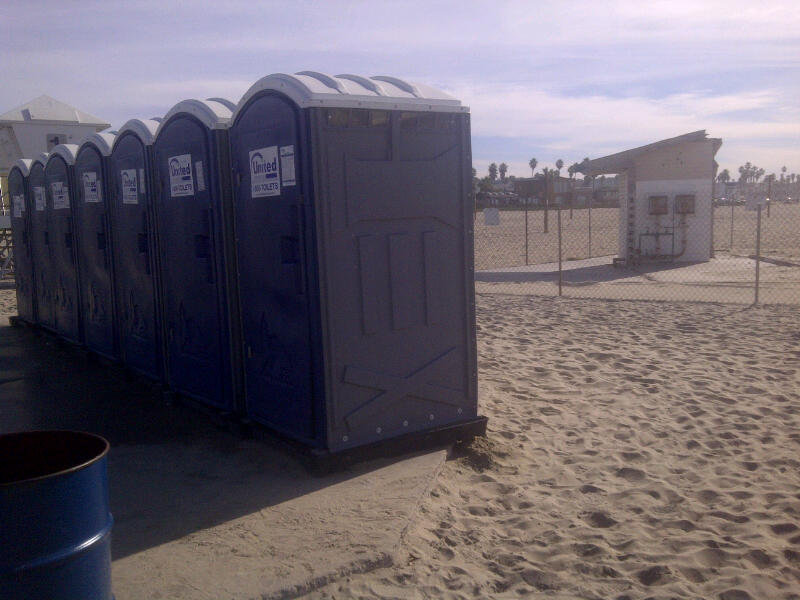
With the number of visitors to Ocean Beach waning during in the winter months, the need for access to public restrooms has become minimal. Stores and eateries frequently inform passersby that their restrooms are not for public use. Still, three main locations in town generally offer relief: the main lifeguard tower facilities on Abbott Street, Starbucks Coffee on Newport Avenue and facilities in the Dog Beach parking lot with 16 portable restrooms, including two oversize, ground-level stalls for wheelchair access required by the American Disability Act (ADA). The situation for those seeking relief, however, has suddenly become a bit more grim for those who need to go. About three weeks ago, Starbucks closed its restroom doors even to customers, much less the general public. A new “employees only” sign is now posted on the two restrooms. Adding to the problem, in a different location, the portable toilets at Dog Beach were recently scaled back to seven stalls — none of which is now wheelchair accessible. Some locals have their own theory as to why public bathrooms have been so drastically eliminated. Brooke Lombardi, 44, has been a resident since 1970. “I think it’s because of the homeless,” Lombardi said. “They [the homeless] would use the bathrooms a lot. Some seek shelter in the disabled stalls at Dog Beach when it’s cold or raining. Some people here don’t like that.” Similar conclusions are drawn by Anthony Beck, 41, who moved to Ocean Beach about two years ago. He also is an occasional Starbucks customer. “I like to wash my hands before I have my pastry and coffee, but I’m usually not coming from home,” he said. “When I walked in [Starbucks] last week, I had just gotten off work and was totally dirty. The ‘employees only’ sign on the (former) customer restroom door caught me by surprise. Even after I purchased my stuff, the guy wouldn’t let me use the restroom.” Since then, Beck said he hasn’t returned to Starbucks. “I don’t mind people off the street washing up in there, but I’m assuming that maybe other people had a problem with it,” Beck said. Allen Hilowitz, a spokesman for the Seattle-based Starbucks Coffee Co., explained the company’s decision. “First of all, our No.1 concern is for the safety of our customers and employees,” Hilowitz said. “Unfortunately, we had a lot of safety incidents at that particular franchise. They [incidents] increased considerably in 2011 and resulted in a physical attack by a transient on one of our local employees. “We got to a point where local law enforcement had to be at the scene on a daily basis,” he said. The decision to close the restrooms to the public, however, was made in August, according to Hilowitz. It was based on several incidents and, as a result, the Starbucks management team and security/safety team made the call. “We also asked for and received positive advice and help from the local merchants association [Ocean Beach MainStreet Association] and the local law enforcement,” said Hilowitz, “which were both highly supportive of the pending decision to close the restrooms of our Ocean Beach store in order to undermine and prevent disturbances and to keep [transient] individuals outside the store. We wanted to offer a safer environment to our customers and employees.” Hilowitz said the number of incidents drastically declined with the closure of the store’s restrooms. “Many of our loyal customers commented and welcomed the positive change,” he said. Not everyone agrees with that assessment, however. “Somehow, it’s not right,” said Beck. “Same with the Dog Beach [portable restrooms]. I’ve seen people sleep in the big ones. That’s why those two stalls are gone. But what if someone in a wheelchair needs to use the restroom and can’t get into the small ones with the step, or gets stuck and tips over? That could be a big mess for the city. They need to have a stall for the disabled.” Every year, the city’s Park and Recreation Department has reduced the number of portable restrooms during the winter months because of decreased demand. “Normally, we leave five singles [stalls] and one ADA [wheelchair-accessible stall]. At least one has to be there,” said Dan Daneri, the city’s district manager for shoreline parks and beaches. Daneri said he was surprised to learn, however, that both ADA-compliant restrooms at Dog Beach had been removed. “I have not been aware of people sleeping in the ADA’s, nor both [the wheelchair-accessible facilities] having been removed,” Daneri said. “People trying to escape the cold is definitely not the reason for the removal [of the ADA facilities].” Having been surprised at learning of the removals, Dan-eri assured that his order to United Site Services — the company responsible for collecting the stalls — had been to leave five single blue stalls and one ADA-compliant one in the Dog Beach area. “There definitely has been a mistake,” Daneri said. “The order got mixed up somewhere. I will make sure the problem will be fixed before The Beacon publishes this article.” True to his word, the next day five blue single portable restrooms and one brand-new ADA-compliant stall was again available to visitors of Dog Beach.


