


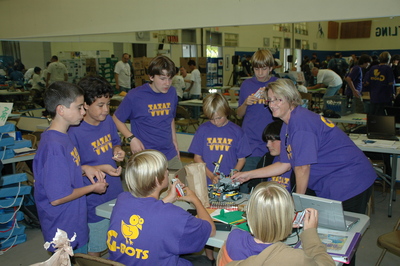
A team of middle school students at Warren-Walker School is building a strong robotics reputation — plastic brick by plastic brick. The Warren-Walker G-Bots will represent the Peninsula area in the FIRST LEGO League (FLL) SoCal Championship Tournament on Saturday at LEGOLAND California. “Engineering is not taught in middle schools very much and this is an opportunity for them to get a hands-on experience of putting a robot together, testing it out and seeing if it works or not,” said Lynn Collins, a G-Bots coach. “It’s practical application. It’s not something out of a textbook.” The G-Bots qualified for the southern California regional with a strong showing at the FLL qualifying tournament held Nov. 15 at Eastlake High School in Chula Vista. Competing against 22 other middle school teams, the G-Bots took first place in technical design of their project and second in overall mission challenges completed. “It’s a pretty significant thing for these guys,” Collins said. “In the last week, they really buckled down and made it all come together and they did awesome. They were pretty incredible.” The team is made up of 10 Warren-Walker Middle School students, including Andrew Williams, Ziven Vonk, Emilio de la Garza, Betsy Tainer, Luke Celeste, Larsen Hayes, Hans Vonk, Spencer Collins, Ruben Medina-Coe and Aden Khalil. Lynn and Ken Collins coach the team. The G-Bots started working on the project when the 2009 FLL Challenge, “Smart Move,” was unveiled in September. Since then, the students have dedicated about seven hours per week outside of school to the project, mostly on Friday afternoons and Sundays. “This is not a class. They volunteer to do this,” Collins said. “They had to organize themselves. They had to with the help of coaches meter their time to get things done in order to put it all together.” The challenge was split up into two parts. In the project phase, teams had to identify a problem with travel within their self-defined community and create a five-minute presentation. The G-Bots delved into high-speed rail. “We looked at magnetic levitation and the use of that for future trains, because high-speed rail is going in along the coast for the future and they wanted to learn more about that,” Collins said. In the robot game part, teams confronted transportation problems by using robotics and sensor technology. The G-Bots had to create and program a robot to complete various missions in a specific amount of time. “They had to build something that wouldn’t fall apart, would rotate and move and had a mechanical arm,” Collins said. “They have to have patience to sit there and program this thing to go so many rotations to the right and follow a line.” The nonprofit organization FIRST — or For Inspiration and Recognition of Science and Technology — was founded in 1989 with the vision of sparking the imagination and creativity of students by making problem solving more interesting. “It starts with the fact that the United States is not leading in the areas of engineering and science,” Collins said. “There was a big push to try and get young people started early thinking about engineering and science.” The G-Bots already appear to be doing more than just thinking.


