


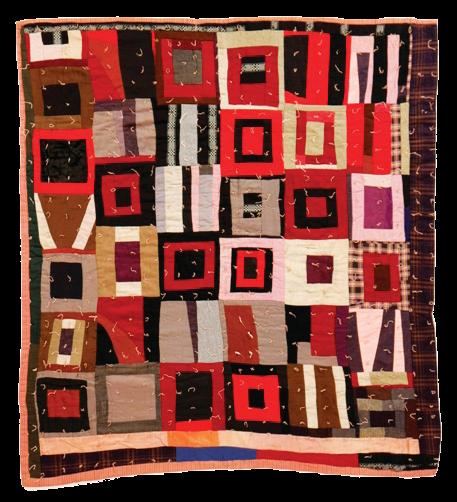

African American Quilts Brighten Mingei Museum
By Jeff Britton | SDUN Art Reviewer
Poor folks didn’t have a lot to work with when it came to making art. But imagination and frugality can be productive comrades, especially in the post-Depression years of the 1930s and 40s.
African Americans in the South made the most of leftovers, whether bits of cotton, wool, denim or flour sacks. And the result is “Bold Expressions: African American Quilts from the Collection of Corrine Riley,” a panoply of more than fifty beautiful hand-sewn quilts, which the former Chicago Art Institute student
began collecting with great enthusiasm many years ago.
A few of those quilts were in the Gee’s Bend exhibit at the venerable De Young Museum in San Francisco several years ago, but what is currently on view at the Mingei International Museum in Balboa Park is more than enough to tantalize audiences with their intricate patterns and riot of colors.
At the gallery’s entry is an asymmetrical summer cotton quilt from Louisiana. Half is in a busy pattern of red, white and blue, while the other half allows the eyes to rest a spell on muted white.
A nice patriotic touch is Sarah Mary Taylor’s flag quilt. The Yazoo City, Miss. native’s work is in a number of museums and were used in the film “The Color Purple,” which starred Oprah Winfrey.
The more difficult the pattern, the more difficult for evil to get to you, particularly in health matters. So went the folk wisdom that inspired Pine Burr Quilt, a dizzying pattern elicited from thousands of pieces of little fabric squares folded into triangles in 1940s Alabama. Families often got together to do this time-consuming work, which has an obsessive quality. Above it hangs Triangles Forming a Mandala Quilt, which in contrast contains an almost spiritual pattern conducive to meditation.
The Red Stars Quilt from East Texas is composed of small stars in various shades of red grounded by a soft blue background and floral borders. Nearby from Indiana is Controlled Crazy Quilt, a terrific sampling of squares of strip construction sewn together to form a giant unit. Opposite is a lovely piece from Mississippi, whose irregular shards of fabric compel your eyes to zoom around it.
Cotton and corduroy remnants make the perpendicular strips of the Multi-Directional Strip Quilt from Kentucky. A subdued wool and cotton creation from Alabama looks at first like an abstract painting in earth tones of beige, gray and black. It also has a great sensitivity to balance.
Two octagonal designs from Mississippi and Louisiana could not be more different. The former made of wool boasts muted colors of red, black and gray, while the other is a kaleidoscope of pastels. Then there is the checkerboard pattern from Georgia that mixes it up with an X or a diagonal cross in a quilt made of cotton and remnants of work clothes.
More elegant is the Bars Quilt, a wool article whose pattern produces serenity in one part and tension in another. If all great art is about contrast, this takes the cake. A Missouri quilt for an infant’s crib indicates a mother’s deep love.
The more Riley saw these quilts the more she seemed inspired by the modernist paintings that surrounded her at the Art Institute. Many are of the “house top” design, since their assemblage resembles that of common log cabin construction in the South.
Become more engaged when the Mingei sponsors a community quilt building workshop for all ages on Sept. 3 from 1-3 p.m. Participants will join quilter, seamstress and professional storyteller Linda Brown in creating personal quilt squares using scrap fabrics. Reservations suggested.
The exhibit continues until Nov. 6. Mingei International Museum, 1439 El Prado, Balboa Park. (619-239-0003 or www.mingei.org.


