


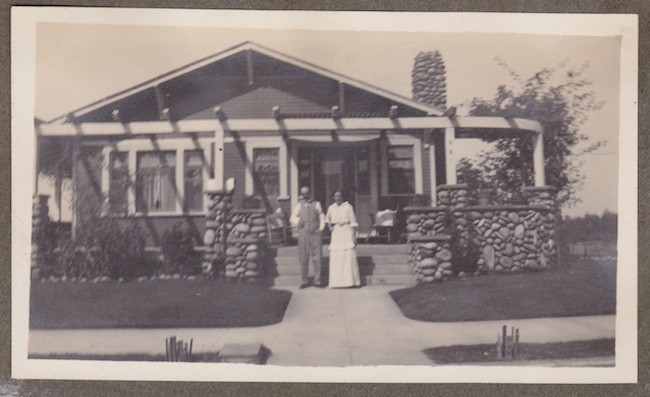
Your personal pic can be part of publishing history with the North Park Historical Society
House Calls | Michael Good
For Moses it’s the Promised Land. For Jason it’s the Golden Fleece. For Monty Python it’s the Holy Grail. But for the old house owner, it’s the photograph. Not just any photograph, mind you, but the photograph of his or her house on day one, the day it was finally completed (and before anyone could come along and mess it up).

The photograph is the one piece of evidence that will unlock the mystery inside the enigma inside the conundrum inside the McGuffin that is your historic home. No longer will you stare forlornly at some architectural detail and ask yourself – because no one will listen to you any longer – “I wonder if that’s original?”
If it’s any comfort for you seekers of pictorial truth, I want to say I feel your pain. Right now it’s in my neck, from lifting boxes for the last two hours trying to find my own missing photograph.
My photo Hegira was prompted by a phone call from my good friend and neighbor, Randy Sappenfeld. Randy is a long-time North Park resident and board member of the North Park Historical Society. It was in that capacity that he called seeking my photograph, which he remembered seeing some time ago. The photograph was of my great grandparents’ bungalow on Granada Avenue, circa 1912, showing my great grandparents, my grandmother, Violet, and my great uncle, Jack. What is perhaps most remarkable about the picture is how the house looks nothing like it does today.
The North Park Historical Society, as Randy explained when he called, is putting together a book of historic photographs as part of the Arcadia publishing series on American communities. Pacific Beach already has one. Cardiff-by-the-Sea already has one. Even Boron, Calif. has an “Images of America” picture book.
Now that it’s been named one of America’s great hipster neighborhoods; now that it’s the place where San Diego’s trendsetters party, drink beer, eat breakfast and consume pork like there’s no tomorrow at the infamous Snack Shack (if you don’t know, don’t embarrass yourself by asking), North Park deserves an Arcadia picture book of its own. And I’d like to contribute, really! There’s only one problem: I’m pretty sure I put that photo someplace special, which is to say I have no idea where it is.
Not that the photograph hasn’t been lost before. I first came across it back in 1996, shortly after my grandmother died at the age of 93. My father and I were going through her garage when I came across a box of memorabilia, including a photo album that contained a number of snapshots with hand-written captions. Along with my grandmother, there was someone I didn’t recognize: my great grandfather, Fred Stock, who died suddenly in 1915, forever changing my family’s financial fortunes.
In the winter of 1996, after we’d distributed, sold or stored my grandmother’s things, I found the bungalow with the help of the City directory. It was only two blocks down Granada Avenue from where my grandmother lived when she died, although it was much changed, having been turned into a faux Spanish-style hacienda. And a few years later, when I saw the photo album again, it too had been changed, having been raided by various family members. Eventually, after my parents passed away, my grandma’s photos and documents ended up with my parents’ photos and documents in some 20 boxes and five file cabinets in my office.
And so that is why, when I opened the box that I thought contained my grandmother’s photo album, I found instead my fourth grade report card among other reminders of personal mediocrity, which I last remember throwing in the trash about 40 years ago (I guess my mother found them and fished them out).
I bring all this up to illustrate why original photos are so hard to come by. First, photographs are fragile and easy to misplace. Second, after the people in the pictures die, a sort of relative free-for-all takes place and everything gets scattered to the wind. Sometimes those that inherit the photos don’t really want to see them again. And finally, photographs often get disconnected from their original context. Photographs of houses without addresses become just that: photographs of houses, without addresses.
The North Park Historical Society would like to change this. The Arcadia “Images of America” book is just one step in a plan to compile photos of North Park houses and people. Right now, the Historical Society has exactly zero images in their collection. The rights to the photographs on their website belong to others, and the same goes for the two publications the society now offers: “North Park: A San Diego Urban Village, 1896-1946” and “Burlingame: The Tract of Character, 1912-1929.”
 Even if they owned a few thousand photos, there is an additional problem. They have nowhere to store them. “Extra copies of our two books are in our garage and the garages of a couple other board members,” said Katherine Hon, Historical Society secretary. So for now, photographs they collect will be stored in the digital “cloud.”
“We’re starting small, with something we call ‘Community Scrapbook,’” Hon said. “It’s just a place online where people can send us a photo and tell us a story. We plan on building on that. We also have a place on the website called ‘Once Upon a Time in North Park.’” It’s a place for a little vignette, rather than a feature story.
As for the book project, Hon is hoping anyone who has a historic photograph of North Park will contact her at [email protected] or 619-294-8990. She will scan your photo (while you stand vigilantly by) and, with some luck, your little piece of personal history will be part of publishing history when the book comes out in 2014, just in time for the Panama-California Exposition centennial.
A small portion of the profits will go to the historical society. “But for us making money isn’t really the point,” Hon said. “Our mission is to educate people about North Park history. We want people to love North Park, because you protect what you love. And we want to protect the architecture and cultural history of North Park.”
Seventeen years ago, when my father and I were going through my grandmother’s garage, I noticed a small tile-topped Monterrey table in the rafters. It had been painted completely white. I asked my father if he knew anything about it. “Never seen it before in my life,” he said dismissively. “Probably something your grandmother picked up at a yard sale.”
I kept it there in the garage, which I ended up, to my surprise, buying, along with my grandmother’s house. Recently, I finally got around to refinishing the table. When I was looking for the missing house photo, I came across one of my father as teenager on his birthday. The birthday cakes – for some reason there are two – are sitting on the tile-topped table, which today, without the white paint, looks almost exactly the same as it does in the photo. I guess sometimes when restoring things you get lucky, and you don’t need the photograph.
—Michael Good es contratista y escritor independiente. Su empresa, Craftsman Wood Refining, restaura carpintería arquitectónica en casas históricas de San Diego. Es un San Diegan de cuarta generación y vive en North Park. Puede comunicarse con él en [email protected].


