


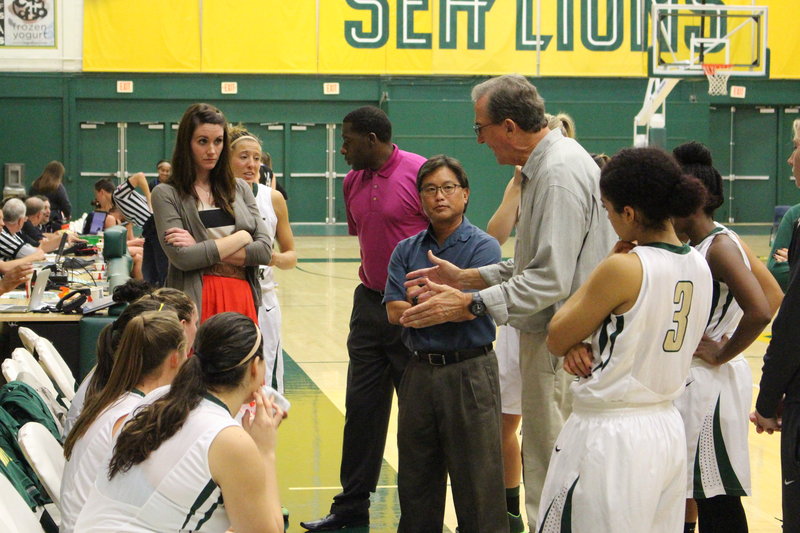
The saying often goes, “The only way to properly learn something is to begin teaching it.” For both Wil Bush and Colleen Planeta this statement could not be more truthful. Both were very successful basketball players as well as student-athletes at Point Loma, and now both have made the transition into coaching alongside the coaches they once played for. Naturally, this begs the question of how did they get to where they are today, and even more so what is the difference between playing and coaching?
There comes a time in every collegiate athletes career when the jersey must be put away, the shoes hung up, and the locker room closed. For some this provides the opportunity to pursue a new career in banking, management, teaching, or physical therapy. However, for others this provides the opportunity to exchange the jersey for a clipboard and to analyze the game they love from a completely different perspective. Both Wil and Colleen chose the latter, albeit not in the most obvious of ways.
After Colleen graduated from Point Loma in 2010, she went on to play professionally in Europe. It was there she finally began to understand her passion for teaching others the game of basketball, “The professional team I played with in Germany required us to work with children at basketball clinics.” Colleen recalled. “It was in those clinics when I finally realized how truly happy I was watching the children learn, grow, and get better. Then the opportunity presented itself at Point Loma and it sounded perfect.”
For Wil, the path wasn’t all too different. Upon graduation from Point Loma, Wil went back home to Seattle and began coaching at the junior college he had previously played at. It wasn’t so much that he knew he wanted to be a coach, but rather it was a way to stay connected with basketball and still allow his passion for the game to grow. After a year away from PLNU, he was offered the job as an assistant coach under head coach Bill Carr, and he jumped at the opportunity. “Coaching,” Wil explained, “wasn’t necessarily something I saw myself getting into, but when Point Loma called I couldn’t resist. The experience I had here was incredible, and if I was going to be able to be part of that again, then I couldn’t possibly say ‘no.'” Both Colleen and Wil spoke about their experience at PLNU being a main deciding factor in coming back. Both had such incredible experiences at the school beyond basketball with the friendships they created with teammates, teachers, and faculty they wanted to be a part of it. “Courneya always refers to the quality of life,” Wil said referring to assistant coach Jordan Courneya. “It isn’t always about how much money you make or being in Division I but rather being a part of something that is truly special.”
But the question remained, ‘why did Point Loma want them to come back and coach?’ Coach Courneya, who was pivotal in both recruiting Wil to play and then hiring him to coach, said it was Wil’s discipline, hard-work, and follow through that have enabled him to make the transition from successful player to successful coach. As a player Wil was known to be one of the hardest working players on the team, if not the hardest worker, and this attribute garnered him respect from teammates and coaches alike. The respect earned from coaches aided him in gaining a rapport with both coach Carr and coach Courneya, but the respect from players has allowed him to come back and coach his previous teammates, Marek Klassen and Hayden Lescault. Coach Courneya pointed to Wil’s hard work, and to the high character of Wil, Hayden, and Marek to allow this transition to be successful. Marek, a fellow 2010 recruit (Wil was a transfer junior, Marek was a freshman) and teammate from 2010-2012, highlighted Wil’s competitiveness and passion for the game of basketball as to why he has been successful in this change. In bringing Colleen back, head coach Bill Westphal emphasized her hard-working mentality, as well as her incredible basketball mind. Colleen attributed her knowledge of the game to her father, a former point guard.
“My dad would teach both my brother and I in the backyard when we were younger. Since my brother was a guard and my dad was as well, he would teach us both ball skills of a guard.” This helped her not only understand her own position, but helped her understand the other positions on the floor, and why plays worked the way they did; something that is a prerequisite for a good coach.
Another aspect both Colleen and Wil spoke about is how they often serve as a bridge of sorts between the older coaches and the players. Since Colleen and Wil played for coach Westphal and coach Carr, respectively, they are familiar with their styles of coaching and are familiar with how things can sometimes be lost in translation between coach and player.
To help combat this, Colleen and Wil try to help players better understand what their coaches expect from them as they know what it was like to be in the players shoes because that’s where they both were not too long ago.
However, the transition from coaching to playing has not been entirely seamless. “It’s hard,” Wil admitted. “It’s hard not being able to play. I definitely miss it; that’s probably the hardest thing about coaching.” Colleen still plays professionally in Australia during Point Loma’s offseason, but when she is coaching she said the hardest part about it is giving up the control from playing. When she was playing, she felt as if she had more control over the final score whereas being a coach allows you some control over the game, but ultimately the players on the court are responsible for the outcome of the game.
But in another respect, they both attribute the growth they have seen in their own skills to their new roles as coaches. “You finally understand the need for preparation, and how it is directly correlated with success,” Colleen acknowledged. She also talked about how the game seemed to slow down for her, and she started to look at plays and players differently than she had before coaching. Wil agreed, but also added in the attention to detail, which can be directly correlated with preparation. “You just see things differently,” he said. “Sometimes a situation presents itself and as a player you don’t always understand what the coach is doing or why he is doing what he is doing, but as coach you begin to understand that more as you do more research and just understand more about the game in general.” Overall, both Wil and Colleen have embraced this changing of perspectives just as the people who know them well knew they would. The most striking thing about both of them is the quiet confidence you hear in their voices as they speak about the game that has done so much in their lives. The transition from player to coach is not always done so gracefully, but for anyone who has met Colleen and Wil they believe this is just the beginning. “She’s going to be successful in anything she does,” Coach Westphal declared. “She’s a winner,” he said as a large smile spread across his face, “one of the best.”
Coach Courneya had very similar praise for Wil, “You don’t become as a good of shooter as Wil was without serious hard-work. He understands what it takes to get to the top, and he has the drive to get there.”
In basketball, and more so in life, perspectives always seem to be changing. For Wil and Colleen they have already encountered one of those changes of perspective, and both are sure to face many more, but until then Point Loma is lucky to have two such incredible, hard-working individuals along their sidelines.


