


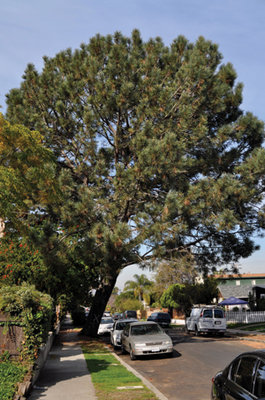
As the city makes plans for the removal of a large, leaning Torrey Pine tree to pave the way for sidewalk repairs in Ocean Beach, residents are going out on a limb to weigh the tree’s potential safety hazard against the scarcity of the species and its majestic presence. Locals debated the issue at the Ocean Beach Planning Board (OBPB) meeting Dec. 1. “While it’s a potential fatality waiting to happen, there was enough strong voice from the local residents that they want to pursue other options,” said Scott Waschitz, who represents OBPB’s District 3. “All sides were represented and the board provided them time to define their stance.” After hearing from city representatives, community members and arborists with a wide range of opinions on the pine, OBPB members unanimously passed a motion to table the matter for 30 days to give all parties time to perform studies and pursue alternatives. The debate will be taken up again at the board’s meeting in January. “By consensus on the board, it seemed most appropriate to give everybody some time,” Waschitz said. “This allows for the public to raise funds and handle this before the city takes care of it.” City officials recently decided the Torrey Pine at 4633 Long Branch Ave. needed to be removed, explaining that its size, shape and lean presented a hazard that would complicate upcoming sidewalk repairs. Though not scheduled for immediate removal, city officials’ findings indicated it would need to come out. “We’re not planning to demolish that sidewalk until the contract starts in March or April,” said Mary Wolford of the city streets division. “At that time, the tree is going to come out.” If the Torrey Pine is removed, it could be replaced — but not with a similar tree because of its size issues. Wolford said the city has a catalog containing trees that are more appropriate for two-foot, four-foot and seven-foot or larger parkways, and the size of the scarce local tree does not fit the size profile of the area. “If this were a park, we could maybe fence off the area and leave the tree. And if it were in a large, open-space canyon area, you could modify and realign the tree,” said Drew Potocki of the city’s Engineering and Capital Projects Department. “In the case of a public street, we don’t have those options.” Those who spoke in support of the tree’s removal pointed to its presence in the public right-of-way and the hazards it presents in the event it should fall. Those objecting to the removal pointed to its the scarcity of the tree species and questioned the need to remove it without determining its health. The extra month buys time for neighbors interested in keeping the tree to see that it is pruned and less cumbersome, and to find a way to pay for the sidewalk removal so a root analysis can be performed. Waschitz said both of tasks require at least $2,500 in funding. “To keep the tree, you are going to have to dig [the sidewalk] up and you are going to have to check the roots. That’s going to cost money,” Waschitz said. Residents interested in donating money or efforts to save the tree can contact OBPB Chairman Giovanni Ingolia by calling (619) 994-8539, or by e-mailing [email protected]. “It’s ultimately up to the direct neighborhood to raise funding and handle this immediately,” Waschitz said.


