


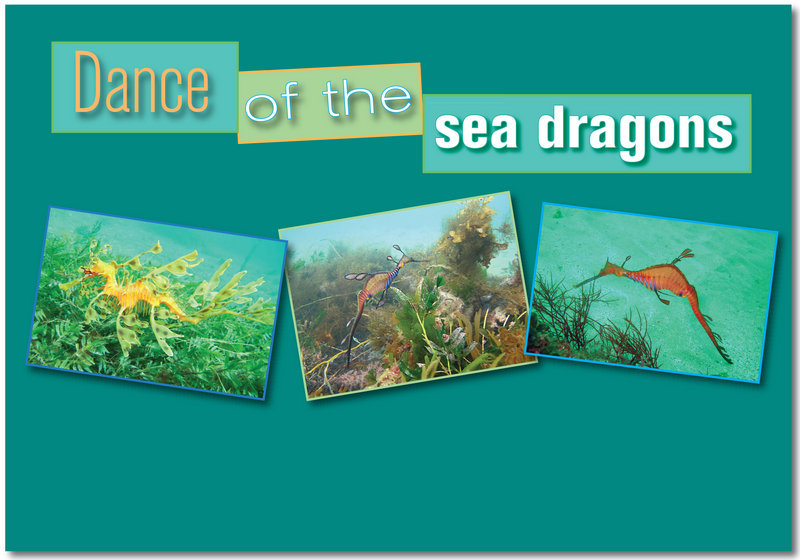
In upright posture with its thick, external armor-encased body, head bent at an angle and a tube snout, one of nature’s true oddities has become the central attraction at Scripps’ Birch Aquarium in its exhibit appropriately named “There’s Something About Seahorses.” The seahorse has been a curiosity of marine biologists for years and, along with its family of sea dragons and pipefish, the study continues. While the seahorses and their relatives in the exhibit provide a fascinating learning experience for visitors, co-curator Leslee Matsushige is hoping researchers at the aquarium can finally answer some burning questions they still have about the animals, particularly the elusive sea dragon. Matsushige — along with Scripps Institution of Oceanography professor Greg Rouse, who has studied sea dragons for years — recently returned from a two-week research trip to several locations in Australia, observing the ornate, leaf-like creatures in their natural habitat and learning about their breeding habits, “to make sure we have a good enough habitat for them here,” she said. Matsushige also met with Alison Edmunds, exhibit manager at Melbourne Aquarium, who has successfully raised weedy sea dragons for several years. Birch scientists are hoping to start a sea dragon breeding program — one of the first in the world — with the help of a $300,000 grant from the Lowe Family Foundation. “Many aspects of sea dragon biology, including their secretive mating behavior, are unknown,” Matsushige wrote on a blog about her trip down under. “To date, no one has ever observed the breeding interaction between males and females of either leafy or weedy sea dragons, the only two sea dragon species.” Sea dragons, Matsushige said, use camouflage to their advantage (“These fish are experts at camouflage, so they are difficult to find if you don’t know they’re there,” she wrote). Adorned by colorful leaf-shaped appendages, they live in weed-covered reefs or sea grass meadows. They feed on mysids shrimp, which thrive in Australia’s Flinder’s Jetty. By observing them in their native environment, Matsushige hopes to shed more light on how Birch Aquarium can prepare for a sea dragon exhibit of its own. “Our aquarium staff has learned a great deal about caring for sea dragons over the past several years, but nothing can compare to the experience of seeing the animals in their natural habitat,” she said. “Observing sea dragons in the wild will help our staff determine how to best showcase these animals at Birch Aquarium and how to design our sea dragon propagation facility.” Seahorse fast facts • Among seahorses, males are the ones who become pregnant and give birth. • Larger seahorses give birth in large quantities, but the offspring are very small and many don’t survive. Smaller seahorses often have fewer but larger babies, and have a greater survival rate. “It all depends on the species and where they’re located,” Matsushige said. • Seahorses aren’t great swimmers; they can be carried away and are often found washed up on beaches after storms. “They can cling to something with their tail, but without a tail fin it can be exhausting,” she said. • Seahorses are notoriously hard to keep. They require intensive care and need to be fed often. • Some species of seahorses can adapt to more temperate conditions and may be found up and down the coast from San Diego to Peru. • One species has been found in San Diego Bay. A permit from the California Department of Fish and Game is required to catch them. • Most of the seahorses exhibited at Birch Aquarium are small and grow to about 12 inches. Their normal life span is about five to seven years, but some have been known to live to the age of 10.


