


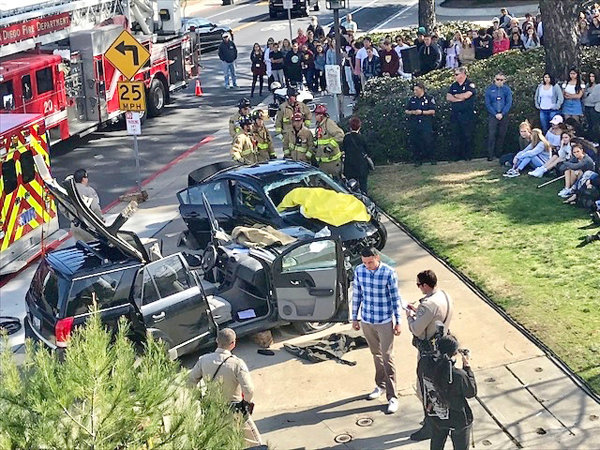
Two students were killed and four others critically injured in a recent head-on crash on Chatsworth Blvd. in front of Point Loma High School as over 800 students looked on.
The sound of sirens filled the air as San Diego firefighters and paramedics raced to the scene with police quickly blocking the street on either side of the horrific scene.
A male student in one car who was thrown through the windshield was pronounced dead at the scene while a girl in the other car was unconscious as firefighters used the Jaws of Life to cut off the roof and a door to free her. She died later at a local trauma center.
The next day, a uniformed California Highway Patrol officer came to a classroom and placed the driver of one vehicle under arrest for drunk driving as wide-eyed students looked on.
Thankfully it wasn’t real.
The accident scene and arrest were the first part of a two-day program for juniors and seniors called “The First 15 Minutes” designed to educate students about the dangers of bad choices while driving, but also a group of parents about the massive penalties that can occur when they provide alcohol or drugs to minors.
Raw emotions surfaced in many aspects of the event.
“It was a really scary experience,” said Charlie Ekstrom who played the unconscious girl in the car who later dies. “We didn’t know what was going on and the Jaws of Life was very loud, a very terrifying feeling having this giant mechanism over you. It’s something that is going to stay with me forever.”
Ekstrom recalls the moment when they pulled a sheet over her and said “it was a very surreal experience and not something I want to go through.”
The program, which included extensive videotaping and an overnight retreat for 31 “Living Dead” students, is funded by a grant from the California Office of Traffic Safety through the National Highway Traffic Safety Administration.
Each year, only 130 high schools in California are selected to participate. PLHS first had the program in 2016.
So realistic was the crash scene that passing motorists called 911 at least three times to report it over the two days.
Before the event began, a video crew used six selected seniors to create the moments leading up to the collision.
One car with three boys skipped school to take a short drive to Plumosa Park where they drank beer and hard liquor before one received a phone call from his coach about a game later that day. Showing lack of coordination, they jumped back into their car to head back to campus.
In the second car were three other students who were headed to an awards program, and as they left northbound on Chatsworth Boulevard the intoxicated boys crossed the center line on the curve just south of Browning Street and the video concluded as the cars were about to collide in a violent head-on crash.
Other elements of the video were added, including the actual parents of the two deceased students at a hospital being told of their children’s fate and talking to them as they lay motionless.
The suspected drunk driver was shown in a jail cell and later in court before a judge where the 18-year-old was sentenced to 26 total years in state prison.
On the first day of the program, all 31 students who had supposedly died in other drunk driving situations were taken after school to a retreat center in Pine Valley where their phones were collected and they participated in activities before spending the night.
That left them out of touch with family and friends and their desks empty in classrooms to increase the feeling among peers they actually had died.
On the first night, parents of the 31 gathered in the school Media Center to hear about the serious ramifications of Social Host laws that punish adults who provide alcohol and/or drugs to minors. They also heard from a father whose wife and three daughters were seriously hurt by a drunk driver in a wrong-way head-on crash on Interstate 15 while returning from a dance competition five years ago. He noted they still have not fully healed.
Several parents struggled visibly when the group wrote letters to their “deceased” children telling them what they would say after their “death.”
“There was a lot of crying,” said Gina Vargus, whose daughter Genevieve Chao was one of the deceased. “It was really tough trying to tell her everything I wanted to and imagining she wasn’t alive anymore.”
Another parent told a reporter her daughter attended two parties in the past three weeks where parents were present and alcohol was served.
“They each received a very angry phone call from me,” she said.
The next day, an assembly in the school’s gym was arranged as a funeral for all 31 students. A casket with flowers was perched on a stand under a spotlight in front of the lectern. The parents sat up front facing their students.
Each of the 31 walked in solemnly holding a candle before taking seats in front of screens where each was shown as a baby and currently with their dates of birth and death.
Tears really began to flow from both students and parents as letters from the previous day were read by both. One boy leaped to his feet and embraced his mother at the conclusion of her letter to him.
Jeramiah Martinez, a veteran trauma center worker, spoke very bluntly to the students about what he had witnessed over the years. His message was both graphic and chilling.
Next was Superior Court Judge Patricia K. Cookson who described her job as “protecting the public” and explained why she has sentenced so many drunk or drugged drivers to prison.
Larry McNamer of MADD (Mothers Against Drunk Driving) then held the students’ interest as he told his tragic personal account of having his 15-year-old son killed by a drunk driver while crossing the street just blocks from home. He drove by the scene minutes later, only to learn the identity of the covered body in the roadway.
To end the program, students were asked to stand if they were committed to not drinking and driving and virtually all stood. Many went to a gym wall where they could write messages and sign their names.
“A lot of my friends were coming up to me in tears,” Ekstrom said. “They want to be part of advocating for no drinking and driving.”
“I think the whole program was very powerful,” said Vargus. “Drinking and driving is a problem everywhere. Kids feel they’re invincible. Last night they talked about Social Host laws and the responsibility for adults to get involved and stay involved to make sure they’re not having opportunities to drink and drive. That’s a huge message.”
PLHS administrators hope to repeat the program in 2020 for current freshmen and sophomores who will be attaining driver licensing age.


