


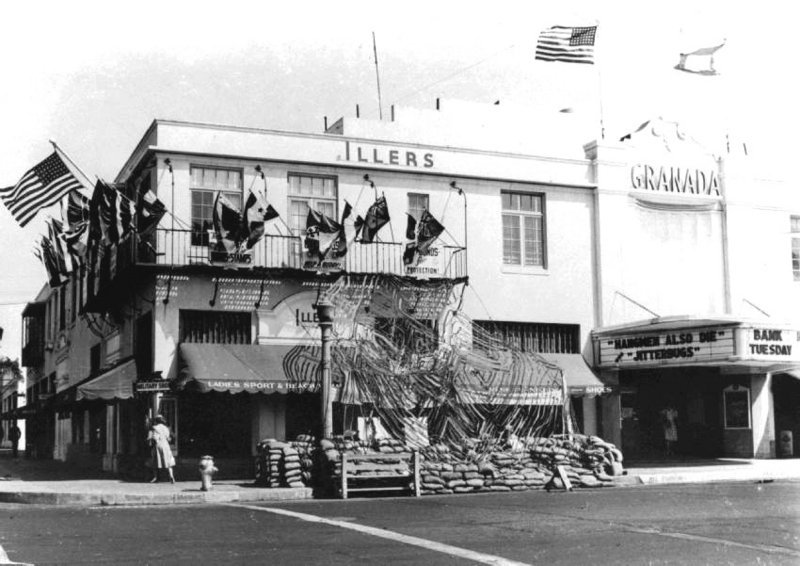
The La Jolla Historical Society has readied an exhibit that has never been done before — one centered specifically on the effects of World War II on north Pacific Beach residents and La Jollans — casting light on local life during the 1940s. The exhibit includes an enlightening component surrounding what was then dubbed the Naval Anti-Aircraft Training Center Pacific Beach — or Bird Rock, “depending on who you ask.” Archivist and curator Mike Mishler and his volunteer staff diligently uncovered little-known facts about local residents during the war for a one-of-a-kind exhibit titled “Homefront La Jolla,” showcasing previously undocumented biographies, photos and war artifacts, which opened for display at Wisteria Cottage on Dec. 7 — the 70th anniversary of the attack on Pearl Harbor — and continuing through Memorial Day. Although the idea of a World War II exhibit had bounced around the historical society’s staff for several years, Mishler nailed down the concept two years ago when he stumbled upon the footlocker of Robert Larimer, a World War II veteran from La Jolla. He knew if there was a perfect time for the exhibit, it was now. “We’re at the point now where it’s the 70th anniversary for Pearl Harbor and it’s almost impossible to get [interviews with] the people who were there,” said Mishler. Additionally, research for the exhibit fills a gap in the historical society’s archives. “We have a really good collection from the founding of La Jolla through the 1930s,” he said. “All the stuff we’ve lived through we don’t really think of as history. Now, we’re able to add to the war periods and the years after the war.” The only trick was telling the story of World War II in a way that has never been told before. “There are tons of histories on WWII — and there are a few on the homefront experience — but not one for La Jolla,” he said. “We tried to find a mix of people with different perspectives. We didn’t just want to get the story of the soldiers, although that’s an important part. We wanted to know what it was like to be a woman in La Jolla in the 1940s, what it was like to be a young mother whose husband was overseas.” Volunteers for the society’s Oral History Program set off on the arduous task of identifying people who lived in La Jolla during those years. The volunteers found more than 20 people, but that was just the first step in an abundance of research that was to be conducted over the course of the year. To help with the daunting task, Mishler enlisted the aid of local high school students to conduct interviews with people who lived in La Jolla during World War II. “It’s been fun because the students ask questions you wouldn’t normally think of. They have a very different perspective,” he said. “They asked a lot of questions about high school — what was school like, what did they do for fun, things like that.” Students also asked what people were doing when they heard about the Pearl Harbor attack, what kind of music they listened to, whether Hispanics or blacks felt marginalized in La Jolla at that time and whether or not they knew any Japanese who were taken away to internment camps. In one particular interview, La Jolla High School student Ana Olevsky interviewed World War II veteran Don Schutte, who was taken as a prisoner of war during the Battle of the Bulge in 1944. During the interview, Schutte showed her his collection of writings and pamphlets from the war — one of which was written entirely in Russian. Although he saved it for all this time, he had never been able to translate it — but Olevsky could. For the first time, Schutte was able to understand the words on the pamphlet that he had held on to for so long, making the interview well worth it for both parties. In addition to profiling the experience of veterans like Schutte, the exhibit will feature documents, histories and artifacts that illustrate the lives of La Jolla residents and workers, the Japanese who were sent to internment camps and La Jolla’s contribution to the war effort. One such homefront contribution that will be showcased is a display of shell casings from a well-known — but little-documented — military base locally. Locals often talk about Camp Callan, Camp Matthews and the bunkers at Mount Soledad, but they rarely speak about the base that was loosely dubbed the Naval Anti-Aircraft Training Center Pacific Beach. Even the newspapers — which were mum on the subject until the site was about to close in 1945 — referred to the base as being in Bird Rock one day and in Pacific Beach the next. “I thought someone was pulling my leg,” Mishler said when he heard about the base. “When you try to find anything about it, you only get stories from people who know about it.” Mishler discovered that the base had served as a naval training center site where sailors would take a six-day course on anti-aircraft artillery. “People talked about the guns going off constantly and the houses getting cracks in them,” he said. “It was only open from 1942 to 1945, but they trained about 300,000 sailors to shoot down aircraft during the course of the war.” Many more previously unexplained facts about La Jolla during the war will be unveiled in “Homefront La Jolla,” at 780 Prospect St. For more information, call (858) 459-5335 or visit www.lajollahistory.org.


