


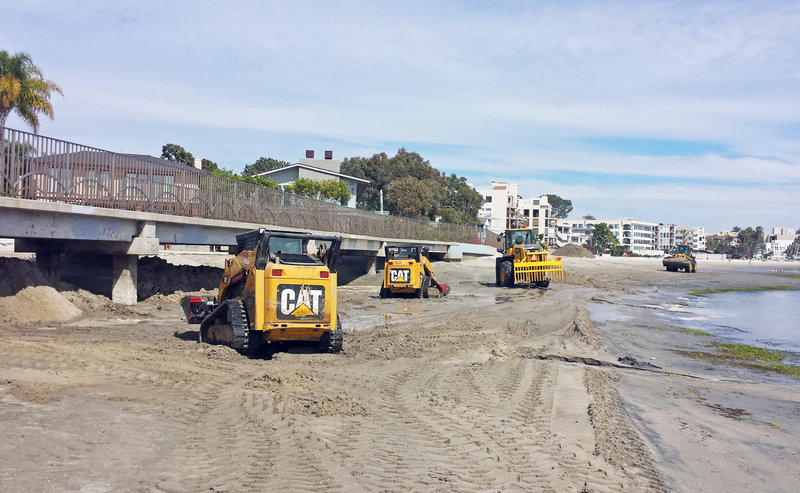
It has taken years to sort out who is responsible, but the City of San Diego has begun the job of dredging sand from Briarfield Cove – a half circle of private beach crossed by a pedestrian bridge in Mission Bay Park on the south and enclosed by single family homes on the north.
Workers from the city’s Park and Recreation Department began work on the project in mid-February, which involves removing about 4,000 cubic yards of sand to restore the cove to its original contours and depths, therefore giving Briarfield Cove homeowners access to Mission Bay.
“As a condition put forward by the Army Corp of Engineers in 1986 – when the city removed sand from the middle of the bay and moved it toward the edges to make beach around the bay – the city agreed to correct the situation at taxpayer expense if the cove silted-in with sand as a result of the city’s work,” said Paul Jacob, associate civil engineer for the City of San Diego.
Jacob said that when the pedestrian bridge was built in 1994, there was enough tidal flow under the bridge to allow homeowners access to the bay. He added that over time, the tide has slowly deposited sand into the cove and closed off its mouth blocking water from reaching the area north of the bridge.
To begin the project, the city utilized a crane on the bayward side of the pedestrian bridge to lift several Bobcat earthmoving machines into the cove to dig a tunnel under the overpass. Dredged sand is then loaded onto city dump trucks by frontloading excavators and transported to Fiesta Island where the city maintains a sand management area.
Jacob said that under normal circumstances, a project such as Briarfield Cove could be completed within a matter of days, but that since the cove is bordered by homes and adjacent to Mission Bay Park, crews are limited to daylight hours of the week during low-tide, which gives them only three to four hours per day and three to four days during the week, which extended the completion time.
A permit was granted in February by the Coastal Commission allowing crews to work until the annual beach area construction moratorium, which limits non-emergency construction work during the summer period from Memorial Day to Labor Day, to minimize the impact on the beach area and residents.
According to Scott Robinson, a public information officer with the City of San Diego’s Public Works Department, the project is estimated to cost more than $48,000 in overtime and equipment rentals fees.
Jacob explained that no one was paying attention and the city didn’t know it was required to maintain the cove until owners wanting to keep the inlet open, brought it up in 2007. He said that he contacted the Army Corp of Engineers and found out that the agreement runs in perpetuity, and the city had to dredge.
Some residents raised concerns about water quality and environmental impacts related to the dredging. Jacobs said that in order to stay away from living biological resources and eel grass – which is a species of special biological significance given its role in providing egg-laying and nursery habitat for fish species – a raised sand berm buffer was created to separate work from the beach.
Other residents expressed concerns that excavating sand would undermine improvements they’ve made to their properties over the years. Jacob said that since most of those improvements were made before the cove started silting, there is very little likelihood of that happening.
Michael Thiemann – a resident since 1997 of one of the homes situated on Briarfield Cove – said that overall, the project is good for homeowners, the city and residents of Pacific Beach.
“It certainly gives us access that we didn’t have in a long time. There are pros and cons to the cove being filled in,” he said. “We had a bigger back yard, but we didn’t have access to the water. Now we do.”
More information on Mission Bay Park can be found at http://www.sandiego.gov/park-and-recreation/parks/regional/missionbay/ or by calling the Visitor Center at 619-276-8200.


