


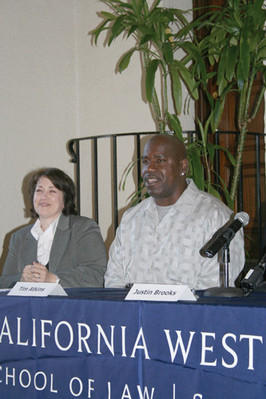
On Feb. 9, Timothy Atkins, 39, walked out of the Los Angeles County jail to take in his first gulp of fresh air as a free man in more than 20 years, thanks to the tireless efforts of a group of graduate students participating in California Western School of Law, San Diego’s California Innocence Project.
In 1987, Atkins was wrongly convicted of one count of murder and two counts of robbery in his hometown of Venice Beach after being falsely identified by an eyewitness.
“It’s over. I made it,” Atkins said to the group of law students and media organizations at a press conference on April 13, announcing the project’s intent to file a state compensation claim of more than $700,000 on Atkins’ behalf. Under California law, exonerated inmates can receive compensation of $100 for every day they were incarcerated.
Students involved in the California Innocence Project, which originated at San Diego’s California Western in 1999, had been working on Atkins’ case since 2002.
The project’s goal is to seek ethical and legal avenues for the release of the wrongfully convicted. Atkins is the fifth wrongly convicted released through Southern California’s Innocence Project.
The project’s faculty and students review more than 1,000 claims of innocence each year. When there is strong evidence of innocence, law students assist in investigating cases, writing briefs and advocating for the release of the client.
Atkins’ release is the product of the hard work of former student Wendy Koen, who searched to re-interview a key witness in the case.
According to Atkins’ defense attorney Justin Brooks, a Venice Beach resident, Denise Powell falsely claimed that she knew the suspect of a series of neighborhood robberies, one of which resulted in a shooting death during an attempted carjacking.
Brooks, also a professor at California Western, said Powell was telling neighbors she knew the suspect.
Police later picked up Powell for questioning, he said.
“They brought her to the police station and what they wanted was a name, not necessarily the truth, but a name,” Brooks said. “And that is the problem with the way police gather evidence. They’re focused on getting the information they want regardless of what the truth is.”
The name Powell gave them was Atkins’.
The female witness, who according to Brooks had only seen the attacker for a brief second on a dark street, also identified Atkins as the suspect.
According to Brooks, the eye-witness identification process was faulty, the eyewitness’ suspect description did not match Atkins description and the police did not use a current photo of Atkins in the photo lineup, according to Jeff Chinn, assistant director for the California Innocence Project.
In September 2004, Koen began searching for Powell, following a former student’s unsuccessful search that lasted two semesters.
Koen made numerous trips to Venice Beach, working with Atkins’ family to track down Powell.
“The best thing that happened to us was Denise was arrested on drug charges,” Koen said, giving them access to a current address for Powell.
According to Koen, she immediately knew that Powell had in fact fabricated her statement.
“She was carrying this load of guilt for 20 years and it had hurt her,” Koen said, adding that Powell had been transient since Atkins’ arrest.
Powell wanted to make things right but was in too deep and without the necessary tools to do so, Koen said.
“What I did was I gave her the tools, I showed her how she could fix this,” Koen said. “I hope that not only is Timothy free, but I think that Denise is now free in a way that she has not been for the past two decades.”
In a fall 2006 hearing, Powell recanted her testimony that helped convict Atkins, saying that she made the confession up and was afraid of changing her story after lying to police.
Los Angeles Judge Michael Tynan, also the original trial judge in 1987, overturned the conviction, saying, “The State has no interest in upholding a conviction obtained by false testimony,” according to a press release.
“From the Bench, he apologized to Tim,” Brooks said.
While Atkins is grateful for the work of the Innocence Project, he worked to release any buried anger towards the judicial system as well as Powell.
“You can never be compensated for 23 years,” Atkins said. He was arrested three years before the conviction.
The trial was postponed due to an injury Atkins suffered in jail that resulted in hospitalization.
“In the beginning I was a little upset,” Atkins said of Powell. “But I had to let that go. Now I feel sorry for her, because she is struggling and needs help.”
Atkins is currently working for a community center in Venice Beach called Venice 2000, an outreach program for residents.
He is also taking a gang intervention course at California State University, Los Angeles.
Powell utilizes the Venice 2000 services and has encountered Atkins since he started working with the program.
“I just want to try to help people,” Atkins said. “If someone had stepped in and helped me a long time ago I probably wouldn’t have ended up in this place.”
The Innocence Project has stepped in to help four other wrongly convicted win back their freedom, including Kenneth Marsh, who served 21 years in prison for murdering his girlfriend’s 2-year-old son.
Medical evidence presented to the San Diego County District Attorney’s Office and the San Diego Superior Court established that the child died in an accidental fall, freeing Marsh from a 15-year to life sentence.
On April 6, Los Angeles County District Attorney Steve Cooley announced that he would not retry Atkins’ case. Unfortunately, Brooks pointed out, this means the actual killer in the 1987 carjacking is still walking free.
For more information on The California Innocence Project visit www.CaliforniaInnocenceProject. org.


